

ESE Lightning Protection System Malaysia —
Wider Protection. Fewer Units.
Fully MS IEC 62305 Certified.
An ESE Lightning Protection System delivers up to 45% wider protection radius than a conventional Franklin rod — covering large factory rooftops, condominium towers, and industrial plants with fewer penetration points and a lower total system cost. TAKO Lightning Protection Solution Sdn. Bhd. — established since 1979, 45+ years of expertise — supplies, designs, installs, and certifies ESE Lightning Protection System for every industry across Malaysia. Suruhanjaya Tenaga Approved. Free site visit included.
ESE Lightning Protection System Malaysia — What It Is & How It Works
An ESE Lightning Arrester (Early Streamer Emission Lightning Arrester) is an active air termination device that uses electrical ionisation technology to emit an upward leader earlier than a conventional lightning rod, attracting the descending lightning leader over a wider radius. This extended protection radius — calculated using the ESE’s advance time (ΔT) per NFC 17-102 standard — allows a single ESE unit to protect a substantially larger area than multiple conventional Franklin rods, reducing the number of air termination points required on large structures.
In Malaysia, ESE Lightning Protection System are used as the air termination component of a complete MS IEC 62305 Part 3 Lightning Protection System — combined with down conductors, equipotential bonding, and an earthing system achieving below 10 Ω. They are the preferred technology for large industrial rooftops, warehouses, condominium towers, and open industrial areas where conventional rods would require excessive installation points. See the full standard explained: What Is the Standard for Lightning Protection in Malaysia.
TAKO Lightning Protection Solution Sdn. Bhd. — certified Total LPS provider since 1979 — supplies, specifies, and installs ESE Lightning Protection System Malaysia as part of complete, Suruhanjaya Tenaga approved systems across all Malaysian industrial zones and building types.
An ESE Lightning Arrester in Malaysia is an active air termination device that intercepts lightning 40–45% earlier than a conventional rod, creating a wider protection zone (typically 30–107m radius depending on height and ΔT value). Under MS IEC 62305 and Suruhanjaya Tenaga’s Arahan/ST/No.4/2019, it forms the air termination element of a complete certified Lightning Protection System — mandatory for applicable commercial and industrial buildings in Malaysia. TAKO since 1979 is Malaysia’s certified ESE Lightning Protection System Malaysia and a leading installer, with 45+ years of expertise.
The ESE 4-Stage Protection Sequence
ESE Lightning Arrester vs Conventional Franklin Rod — Which Is Right for Your Building?
The right air termination technology depends on your building’s roof area, LPL class from the risk assessment, structural complexity, and budget. TAKO specifies ESE or conventional technology based on the MS IEC 62305-2 risk assessment — never a generic recommendation.
| Factor | ESE Lightning Arrester | Conventional Franklin Rod | TAKO Recommendation |
|---|---|---|---|
| Protection Technology | Active — early streamer emission (ΔT advance) | Passive — fixed cone-shaped interception zone | ESE for large or complex roof areas |
| Protection Radius | 30–107m radius (height + ΔT dependent) | 45–60° cone from rod tip | ESE covers larger area per unit |
| Units for 5,000 m² Roof | Typically 1–3 ESE units | Typically 8–18 conventional rods | ESE — fewer roof penetrations |
| Unit Cost (Supply) | RM 3,000–RM 18,000 per ESE unit | RM 600–RM 1,800 per rod | ESE total cost often lower for large roofs |
| MS IEC 62305 Compliance | ✓ Fully compliant (Part 3) | ✓ Fully compliant (Part 3) | Both — selection is site-specific |
| NFC 17-102 / UNE Certification | ✓ Required for ESE products | Not applicable | TAKO supplies certified ESE models only |
| Maintenance Requirement | Annual ioniser functional test | Annual visual inspection | Conventional — marginally simpler maintenance |
| Best Application in Malaysia | Large factories, warehouses, condominiums, open industrial areas | SME factories, smaller commercial, residential high-rise | TAKO assesses and specifies — never one-size-fits-all |
| ESE and conventional rod pricing is indicative for 2025 Malaysian supply. Total project cost includes risk assessment, installation, earthing system, SPD integration, commissioning, and ST documentation. Cost guide: Lightning Arrester Cost in Malaysia. WhatsApp TAKO at +60 12-550 6836 for a site-specific quotation. | |||
Where TAKO Installs ESE Lightning Arresters Across Malaysia
ESE Lightning Arresters are the preferred air termination solution for large-area and high-consequence buildings. TAKO installs certified ESE systems for all of the following across every Malaysian state — Selangor, KL, Penang, Johor, Pahang, Terengganu, Sarawak, and Sabah.
- Large factories & automotive plants — Shah Alam, Klang, Subang, Rawang. Wide rooftops with minimal penetration requirements make ESE the cost-effective choice
- Warehouses & logistics parks — Port Klang, Shah Alam 3PL, Subang cargo. Flat roofs of 5,000–50,000 m² covered efficiently with 2–4 ESE units
- Condominium towers & high-rise residential — Compliant with Suruhanjaya Tenaga JMB/MC obligations. ESE on roof covers plant rooms, lift motor rooms, and terraces. See: Best Lightning Protection Systems in Malaysia
- Petrochemical & chemical plants — Pasir Gudang, Kertih, Gebeng. LPL I systems require tightest protection. ATEX-zone compatible ESE models available
- Commercial high-rise offices & hotels — KL City, Penang, Iskandar Malaysia. ESE on rooftop combined with mesh system for complete coverage
- Ports & marine facilities — Port Klang, Johor Port, Bintulu. Coastal-rated ESE models for salt-air environments
- Educational institutions & stadiums — Open-air facilities with wide coverage requirements. ESE + Thunderstorm Warning System for outdoor safety
- Johor Bahru industrial & commercial — See dedicated guide: Best Lightning Protection System in Johor Bahru
Earthing is non-negotiable: An ESE Lightning Arrester can only discharge lightning current safely if the earthing system achieves below 10 Ω. TAKO designs the earthing network alongside the ESE installation — not as a separate purchase. Full guide: Understanding the Earthing System in Malaysia and Advanced Rod Earthing Installation.
Why Choose TAKO for ESE Lightning Arrester Installation in Malaysia
FAQs — ESE Lightning Arrester in Malaysia
What is an ESE Lightning Arrester and how is it different from a conventional rod?
Is an ESE Lightning Arrester compliant with MS IEC 62305 and Suruhanjaya Tenaga requirements?
How much does an ESE Lightning Arrester cost to install in Malaysia?
Does an ESE Lightning Arrester protect all of my factory or condominium?
Why choose TAKO for ESE Lightning Arrester installation in Malaysia?
At TAKO, we’re proud of our 20+ years of leading the way in lightning protection. Since 1979, we’ve been at the forefront, providing top-notch solutions to shield structures from lightning damage. Our focus here is on our budget-friendly Early Streamer Emission (ESE) Lightning Protection System. It’s all about boosting safety while cutting risks.
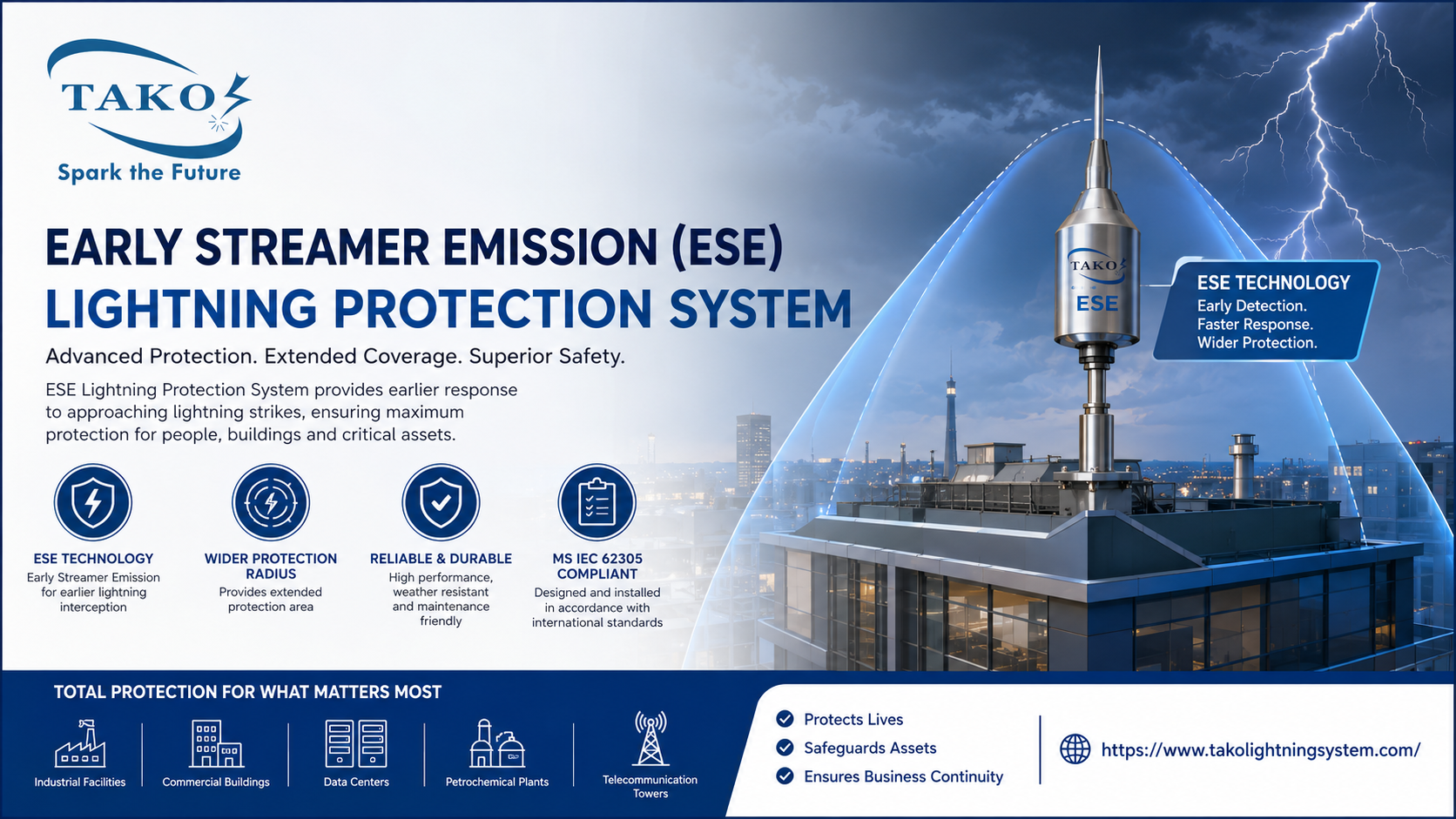
ESE Lightning Protection System

Early Streamer Emission (ESE) technology stands as a cutting-edge advancement in lightning protection. TAKO designed an ESE Lightning Protection System to provide better safety. This system does so by giving early warnings and emitting streamers before lightning strikes. This proactive approach sets our system apart, providing crucial additional seconds for individuals and assets to secure shelter.


What is Early Streamer Emission?
Early Streamer Emission (ESE) technology represents a paradigm shift in lightning protection, offering a proactive defense against the unexpected forces of nature. We design our ESE Lightning Protection System with precision to give an early warning. It detects lightning discharges before they happen. This unique feature distinguishes our system, giving people and valuable items time to find shelter quickly.
How ESE Technology Works?
At its core, ESE technology leverages the principles of physics to emit streamers ahead of an impending lightning strike. We strategically designed the system to anticipate the formation of ionization in the atmosphere, helping the release of streamers. These streamers, in turn, create an ionized path that redirects the lightning towards the grounded lightning rod.
The ESE Lightning Protection System boosts safety by releasing streamers early. This extends the protection area, shielding against active lightning strikes. It keeps people safe and protects vital assets, infrastructure, and equipment.

In conclusion, TAKO since 1979 stands as a beacon of excellence in the field of lightning protection. We promise to offer affordable, tailored solutions. Our track record and skilled team make us industry leaders. For those seeking advanced lightning protection without compromising on safety or budget, TAKO is the trusted partner.
Disclaimer
The information contained in this blog is for informational and marketing purposes only and should not be taken as professional advice. Our focus is on providing comprehensive LPS total solution services. This service encompasses a wide range of solutions to design, install, and maintain a complete lightning protection system tailored to your specific needs. For any questions or to discuss your specific lightning protection needs, please contact us directly.
TAKO’s Credentials


FAQs
What is an ESE system?
An ESE (Early Streamer Emission) system helps protect buildings from lightning strikes. It has a lightning rod with a device that releases ions into the air early. This ESE air terminal and its system make a path for lightning to follow, reducing the risk of damage.
How does the ESE type lightning arrester work?
ESE lightning arresters function by releasing ions into the air nearby, making a path for lightning. Sometimes, people also call them early streamer emission air terminals. When a storm comes, the system’s early emission technology lets out ions beforehand. This makes the lightning rod cover a larger area, improving the protection around the building.
What is the difference between conventional and ESE lightning protection?
Conventional lightning protection relies on passive rods and conductors without the ionization feature. In contrast, ESE systems incorporate ionization technology to enhance the effectiveness of lightning capture. ESE systems claim to provide a larger protection radius and earlier triggering of the lightning strike path
What are the benefits of ESE lightning arresters?
– Extended protection radius: ESE systems claim to offer a larger area of protection compared to conventional lightning protection.
– Early streamer emission: The ionization technology promotes an early triggering of the lightning strike path.
– Improved efficiency: ESE lightning arresters can optimize lightning capture and dissipation.

