

When we talk about lightning, most people think of a quick flash and a loud boom. But for facility managers overseeing oil refineries, data centers, or chemical processing plants, lightning represents a multi-million dollar threat. In these environments, “standard” solutions aren’t just insufficient—they’re dangerous. This is where Custom Lightning Protection for High-Risk Facilities moves from a “nice-to-have” to a critical operational requirement.
In this guide, we will break down why specialized engineering is the only way to safeguard high-stakes assets, the technical pillars of a robust system, and the reality of how these systems are actually built to survive the elements.
TAKO since 1979 has over 25+ years of Experience in offering MS IEC 62305 Compliant Best Lightning Protection System in Malaysia.


How to Install a Lightning Rod: The Professional Approach
If you are searching for how to install a lightning rod, it’s likely because you recognize a vulnerability in your structure. However, for industrial sites, the process is far more complex than simply “bolting a rod to a roof.”
Quick Steps for Industrial Installation:
- Conduct a Risk Assessment: Use NFPA 780 standards to determine the lightning strike frequency and potential impact.
- Determine Protection Zones: Use the “Rolling Sphere Method” to identify where air terminals (lightning rods) must be placed.
- Select the Right Materials: Use Class I or Class II materials based on the height and purpose of the building.
- Secure Air Terminals: Mount terminals at the highest points and around the perimeter.
- Establish Down Conductors: Create a low-impedance path to the ground, ensuring at least two paths for every system.
- Grounding System Integration: Bond the conductors to a specialized grounding electrode system.
- Surge Protection: Install Surge Protective Devices (SPDs) at all service entrances.
Note: While understanding how to install a lightning rod is helpful for residential use, high-risk facilities require certified Master Designers to ensure the system doesn’t accidentally cause a fire via side-flashing.
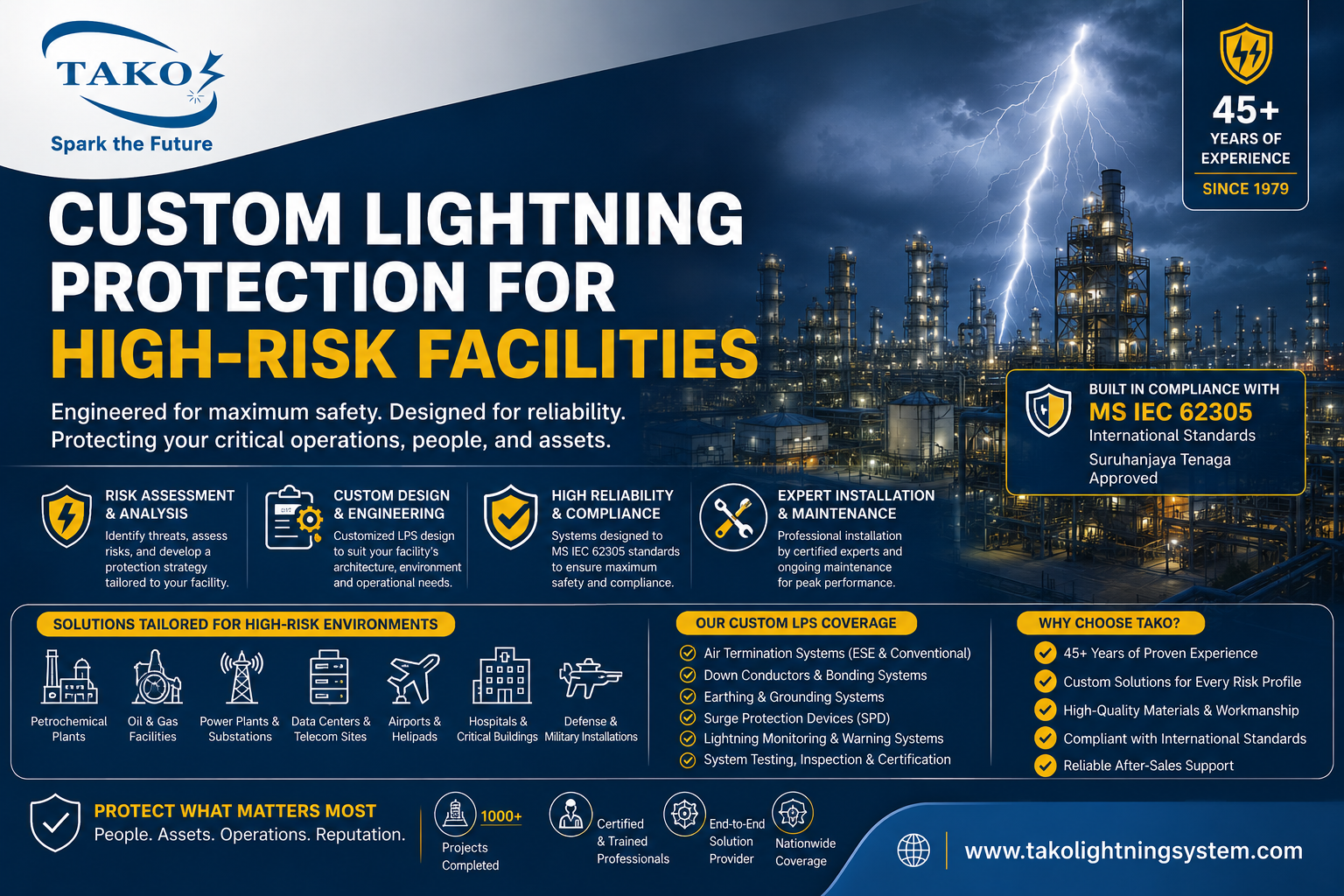
Why “Off-the-Shelf” Fails High-Risk Sites
Every facility has a unique “electrical signature.” A data center in a valley has different needs than a hydrogen storage tank on a coastal plain. Relying on a generic kit instead of Custom Lightning Protection for High-Risk Facilities is a gamble with your infrastructure.
High-risk facilities often deal with:
- Volatile Atmospheres: Where a single spark can lead to an explosion.
- Sensitive Electronics: Where even a nearby strike (not a direct hit) can fry PLC systems via electromagnetic induction.
- High Uptime Requirements: Where a 10-minute power surge can result in days of forensic data recovery.
Custom Lightning Protection for High-Risk Facilities addresses these nuances by integrating the architecture, the local soil chemistry, and the specific electronic vulnerabilities of the site into one cohesive shield.

The Engineering Behind Custom Lightning Protection for High-Risk Facilities
To build a system that actually works, engineers look at the “Six Points of Protection.” This is the gold standard for Custom Lightning Protection for High-Risk Facilities.
1. Capture the Strike
The goal isn’t to “attract” lightning, but to provide a preferred point of attachment. In Custom Lightning Protection for High-Risk Facilities, we use specialized air terminals that are placed with surgical precision to ensure the lightning has nowhere to go but our system.
2. Convey the Energy Safely
Once the strike is captured, the energy must be moved. If your down-conductors aren’t properly routed, the electricity can “jump” to nearby metal pipes or electrical wires. This is called a side-flash. Proper Custom Lightning Protection for High-Risk Facilities ensures that the path to the ground is the path of least resistance.
3. Dissipate into the Ground
This is where many systems fail. If your soil is rocky or dry, it won’t absorb the energy. Professional Custom Lightning Protection for High-Risk Facilities involves soil resistivity testing. Sometimes, we have to use chemical ground rods or deep-earth wells to ensure the energy is neutralized safely.
4. Bond All Systems
If your lightning protection system isn’t “bonded” to your electrical ground, you create a potential difference. During a strike, this can cause a massive surge between the two systems. Custom Lightning Protection for High-Risk Facilities creates an “equipotential plane,” meaning everything stays at the same voltage level, preventing internal arcing.
5. Protect the Data Lines
Most people focus on the roof, but the real damage often comes through the phone lines, internet cables, and power feeds. Part of a Custom Lightning Protection for High-Risk Facilities package is the installation of high-tier Surge Protective Devices (SPDs).
6. Protect the Power Quality
Consistent power is the lifeblood of industrial sites. Custom systems ensure that even the smallest “transient” surges—the ones you don’t even notice—are filtered out before they degrade your equipment’s lifespan.
Technical Spotlight: How to Install a Lightning Rod Properly in 2024
When looking at how to install a lightning rod, the technology has evolved. We no longer just use copper “points.” Modern industrial installations often use:
- Early Streamer Emission (ESE) Terminals: Designed to trigger a “upward leader” faster than traditional rods.
- Charge Transfer Systems: Which aim to reduce the static buildup on a building to make a strike less likely in that specific spot.
If you are researching how to install a lightning rod for an industrial site, you must ensure that your installation follows NFPA 780 or IEC 62305. Without these certifications, your insurance provider may deny claims following a strike.
Industry-Specific Needs for Custom Lightning Protection for High-Risk Facilities
Oil, Gas, and Chemical Plants
In these environments, the “zone of protection” must be absolute. We often see “isolated” systems here, where the lightning protection is physically separated from the tanks containing flammable vapors. This is a hallmark of high-tier Custom Lightning Protection for High-Risk Facilities.
Data Centers and Critical IT
For a data center, the “strike” is only half the battle. The electromagnetic pulse (EMP) from the strike can wipe hard drives or crash servers. Custom Lightning Protection for High-Risk Facilities in this sector involves heavy “shielding” and transient voltage surge suppression.
Military and Munitions Storage
When you are storing explosives, there is zero room for error. Custom Lightning Protection for High-Risk Facilities for the military often involves “catenary systems,” which are overhead wires suspended above the facility to catch lightning before it even gets close to the structure.
The Risk Assessment: The First Step in Custom Lightning Protection for High-Risk Facilities
You can’t manage what you haven’t measured. A huge part of Custom Lightning Protection for High-Risk Facilities is the initial Risk Assessment. Engineers look at:
- Lightning Flash Density: How often does lightning actually hit your specific GPS coordinates?
- Structural Material: Is the building steel-framed (which acts as a partial shield) or masonry (which can explode when hit)?
- Contents Value: Are you protecting hay or a $50 million server farm?
- Consequences of Failure: Does a strike lead to a 5-minute outage or a massive environmental spill?
By analyzing these variables, experts can design Custom Lightning Protection for High-Risk Facilities that fits the budget while maximizing safety.
Maintenance: Don’t “Set It and Forget It”
Even the best Custom Lightning Protection for High-Risk Facilities will degrade over time. Ground rods can corrode, and connections can loosen due to wind and thermal expansion.
If you know how to install a lightning rod, you also know that the “grounding” is the most vulnerable part. Annual inspections should include:
- Continuity Testing: Ensuring the path from the roof to the ground is still solid.
- Ground Resistance Testing: Checking if the soil conditions have changed.
- Visual Inspection: Looking for corrosion or damage from previous strikes.
Investing in Custom Lightning Protection for High-Risk Facilities means investing in the long-term health of that system through a dedicated maintenance contract.
Why Professional Design Trumps DIY
We often get asked by facility managers if they can just follow a guide on how to install a lightning rod and have their maintenance team do it.
The answer is usually “No.”
Here is why:
- Liability: If a fire occurs and the system wasn’t installed by a certified LPI (Lightning Protection Institute) professional, insurance companies often walk away.
- Precision: Custom Lightning Protection for High-Risk Facilities requires specialized tools, like 3-pole ground resistance testers, which most maintenance teams don’t have.
- The “Side-Flash” Risk: An amateur installation might actually increase the risk of fire by bringing high-voltage energy into the building without a properly engineered path out.
The ROI of Custom Lightning Protection for High-Risk Facilities
It’s easy to look at the cost of a custom system and hesitate. But consider the alternative.
- The cost of a custom system: $20,000 – $100,000+ (depending on site size).
- The cost of a single strike: Millions in equipment damage, weeks of downtime, and potential legal fees if safety standards weren’t met.
Custom Lightning Protection for High-Risk Facilities is essentially an insurance policy that pays for itself the first time a storm rolls through your area. When you see the lights flicker but your machines keep running, that is the ROI of a custom-engineered solution.
Conclusion: Taking the Next Step
Whether you are managing a solar farm, a hospital, or a manufacturing hub, the threat of lightning is real and increasing due to changing global weather patterns. Relying on outdated or generic protection is a risk you don’t have to take.
By prioritizing Custom Lightning Protection for High-Risk Facilities, you aren’t just protecting a building; you’re protecting your people, your data, and your future.
Don’t wait for a “near miss” to realize your facility is vulnerable. Understanding how to install a lightning rod is a great starting point, but implementing a full-scale, custom-engineered defense is the only way to ensure total peace of mind.
Ready to Secure Your Facility?
Don’t leave your most valuable assets to chance. Our team specializes in Custom Lightning Protection for High-Risk Facilities, providing end-to-end solutions from site audit to certified installation.
FAQ: Common Questions About Custom Lightning Protection for High-Risk Facilities
Does a metal roof act as a lightning rod?
No. While a metal roof is conductive, it is often too thin to handle the heat of a strike without melting. Custom Lightning Protection for High-Risk Facilities is still required to move the energy safely to the ground.
How long does it take to install a custom system?
Depending on the complexity, a Custom Lightning Protection for High-Risk Facilities installation can take anywhere from a few days to several weeks.
Can I install my own system if I know how to install a lightning rod?
For a shed or a small house, perhaps. For high-risk facilities, it is legally and practically required to have a certified professional handle the design and installation to meet safety codes.
What is the most important part of Custom Lightning Protection for High-Risk Facilities?
The grounding system. If the energy can’t leave the building and enter the earth efficiently, the entire system is useless.
Disclaimer
The information provided in this blog is intended for general informational purposes only. Prices, specifications, and availability may vary depending on suppliers, location, and market conditions. Readers should verify details directly with suppliers or manufacturers before making purchasing decisions. The author and website are not responsible for any errors, omissions, or outcomes resulting from the use of this information. Always consult a professional for advice tailored to your specific needs.
TAKO’s Credentials


