
A single, catastrophic event is all it takes. One lightning strike can unleash a torrent of destructive energy, causing tens of thousands of dollars in damage to a high mast lighting pole. Beyond the immediate financial blow, the resulting safety hazards, prolonged downtime, and service interruptions create a cascade of operational nightmares. For engineers, municipal managers, and airport authorities, the integrity of these critical structures is not a matter of chance—it’s a matter of calculated protection. Implementing a robust high mast lightning protection system isn’t a luxury or an afterthought; it is a fundamental engineering necessity for any responsible infrastructure project.
This blog delves into the critical aspects of effective high mast lightning protection. We will explore the unique vulnerabilities of these structures, break down the essential components of a life-saving system, and underscore the vital importance of adhering to established codes and standards. Our goal is to equip you with the knowledge needed to specify, install, and maintain a system that stands up to the forces of nature, ensuring safety, reliability, and long-term value.
Why High Mast Lighting is Uniquely Vulnerable to Lightning
To understand the solution, we must first appreciate the problem. The vulnerability of high mast poles boils down to a simple, unforgiving principle of physics: lightning seeks the path of least resistance to the ground.
The Simple Physics of a Tall Target
High mast lighting poles, often towering between 100 and 200 feet, are frequently the tallest structures in their vicinity. Highways, interchanges, sports complexes, and airport aprons are typically vast, flat expanses. In such a setting, a metal pole becomes a natural lightning magnet, intentionally designed to elevate lights high into the air, but inadvertently creating an ideal strike point.
A typical lightning strike carries an awesome and terrifying amount of energy—often exceeding 100 million volts and 30,000 amps. This energy is released in a fraction of a second, generating temperatures hotter than the surface of the sun. Without a dedicated and robust path to channel this energy, the results are predictable and devastating.
The Dire Consequences of Inadequate Protection
When a high mast pole lacks proper high mast lightning protection, the strike will find its own path, with destructive consequences:
- Structural Damage: The immense heat can instantly vaporize metal, causing pitting, welding, or even cracking the steel pole itself. This compromises the structural integrity, posing a collapse risk.
- Electrical System Destruction: The sensitive internal components—photocells, HID ballasts, LED drivers, and wiring—are instantly fried. The cost of replacing these components, coupled with the crane rental needed for lowering the pole basket, is exorbitant.
- Dangerous Side-Flashing: If the resistance of the pole is higher than the path through the air to a nearby object, the lightning may “flash over,” jumping to ladder rungs, service cables, or even a person.
- Power Surges: The lightning’s energy can travel back through the electrical grid, damaging substations and other connected equipment far from the strike point.
This is why a proactive, engineered approach to high mast lightning protection is the only responsible course of action. It’s not about if a strike will occur, but when.
Core Components of a High Mast Lightning Protection System
An effective defense is multi-layered. It’s a common misconception that a single lightning rod is sufficient. In reality, a complete high mast lightning protection system is a synchronized network of components working in concert to intercept, channel, and dissipate the lightning’s energy safely. Proper high mast lightning protection is always a system, never a single product.
1. The Air Terminal (Lightning Rod)
The air terminal is the most visible component—the spearhead of your defense. Its purpose is not to attract lightning but to provide a preferred point for the strike to terminate, intercepting it before it can damage the pole or luminaires. Constructed from highly conductive, corrosion-resistant materials like copper or aluminum, it is mounted at the absolute highest point of the structure. The design and placement of this terminal are critical for the overall efficacy of the high mast lightning protection system.
2. The Down Conductor
This is the lightning’s designated superhighway. The down conductor is a heavy-duty cable that provides a continuous, low-impedance path from the air terminal to the grounding system. Its job is to safely conduct the massive electrical current of the strike away from the sensitive upper sections of the pole. The size of this cable is not arbitrary; it is specified by codes like NFPA 780 to handle the anticipated current without fusing or vaporizing. Any compromise in the down conductor is a critical failure point for the entire high mast lightning protection scheme.
3. Bonding: The Critical Connection
Perhaps the most overlooked aspect of high mast lightning protection is bonding. It is not enough to have a single down conductor; all other substantial metal components on or near the pole must be electrically bonded to it. This includes the access ladder, service door, internal cable supports, and even rebar in the foundation.
Why is this so crucial? Without bonding, these metal objects create potential differences in electrical potential. When lightning travels down the main conductor, the energy can “jump” or side-flash to these unbonded components to find a better path to ground. This creates extreme arcing and sparking hazards, especially at the base where personnel might be present. Proper bonding ensures everything is at the same electrical potential, eliminating this dangerous side-flashing and creating a unified high mast lightning protection envelope.
4. The Grounding System (Earth Electrode System)
If the down conductor is the highway, the grounding system is the final destination. This is arguably the most important component of the entire high mast lightning protection system. A perfect air terminal and a massive down conductor are rendered completely useless if the lightning energy has nowhere to go.
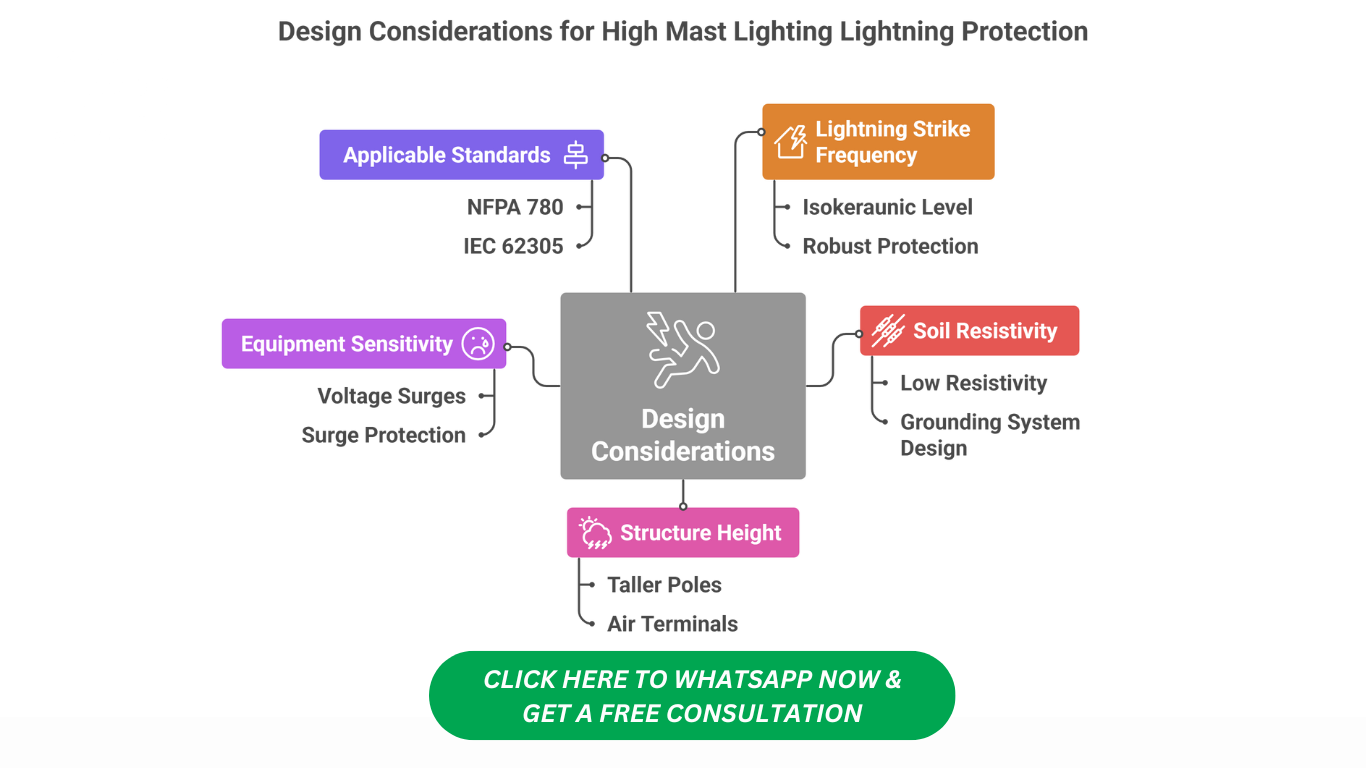
The grounding system consists of earth electrodes—typically copper-clad ground rods driven deep into the soil—connected together to form a ground ring around the pole’s base. The objective is to create a low-resistance connection to the earth, allowing the massive electrical charge to dissipate safely and harmlessly into the ground. The soil’s resistivity dictates the design and extent of this system, making site-specific engineering a key part of effective high mast lightning protection.
5. Surge Protection Devices (SPDs): Guarding the Electronics
While the previous components handle the direct strike (the “outside” threat), Surge Protection Devices (SPDs) handle the induced transient surges (the “inside” threat). A lightning strike, even a nearby one, can induce powerful voltage surges in the electrical wiring running up the pole. These surges are more common than direct strikes and are equally destructive to electronic components.
SPDs act as pressure-relief valves for your electrical system. They are installed at key points—typically at the service entrance (base of the pole) and within the luminaire compartment—to detect voltage spikes and instantaneously shunt the excess energy to ground. Integrating Type 1 and Type 2 SPDs is a non-negotiable part of a modern, comprehensive high mast lightning protection strategy, especially with the proliferation of sensitive and expensive LED lighting systems.
Adhering to Standards: The Role of MS IEC62305 and IEEE
Installing hardware is one thing; installing it correctly according to a recognized standard is what separates a guess from a guarantee. This is where your high mast lightning protection plan transitions from theoretical to trustworthy.
Following the Code: MS IEC62305 is Your Blueprint
The benchmark for lightning protection is MS IEC62305, the Standard for the Installation of Lightning Protection Systems. This document is not a suggestion; it is a meticulously researched and peer-reviewed set of requirements that governs the design, materials, and installation methods for lightning protection systems.
A compliant high mast lightning protection system is one that is designed and installed in strict accordance with MS IEC62305. This includes specifications for:
- Air terminal height and spacing.
- Down conductor size and material.
- Bonding requirements and methods.
- Grounding system design and resistance thresholds.
Specifying an “MS IEC62305” system ensures you are not relying on anecdotal advice or substandard practices. It is the single greatest step you can take to ensure the authoritativeness and reliability of your installation.
Complementary IEEE Standards
While MS IEC62305 focuses on the structural protection from direct strikes, standards from the Institute of Electrical and Electronics Engineers (IEEE) provide crucial guidance on the electrical side. For instance, standards like IEEE 1410 provide recommended practices for improving grounding systems to mitigate surge-related damage. Referencing these standards in your project specifications demonstrates a deep and thorough understanding of the complete high mast lightning protection challenge.
Beyond the Code: Proactive Best Practices
True expertise goes beyond the minimum code requirements. A best-practice approach to high mast lightning protection includes:
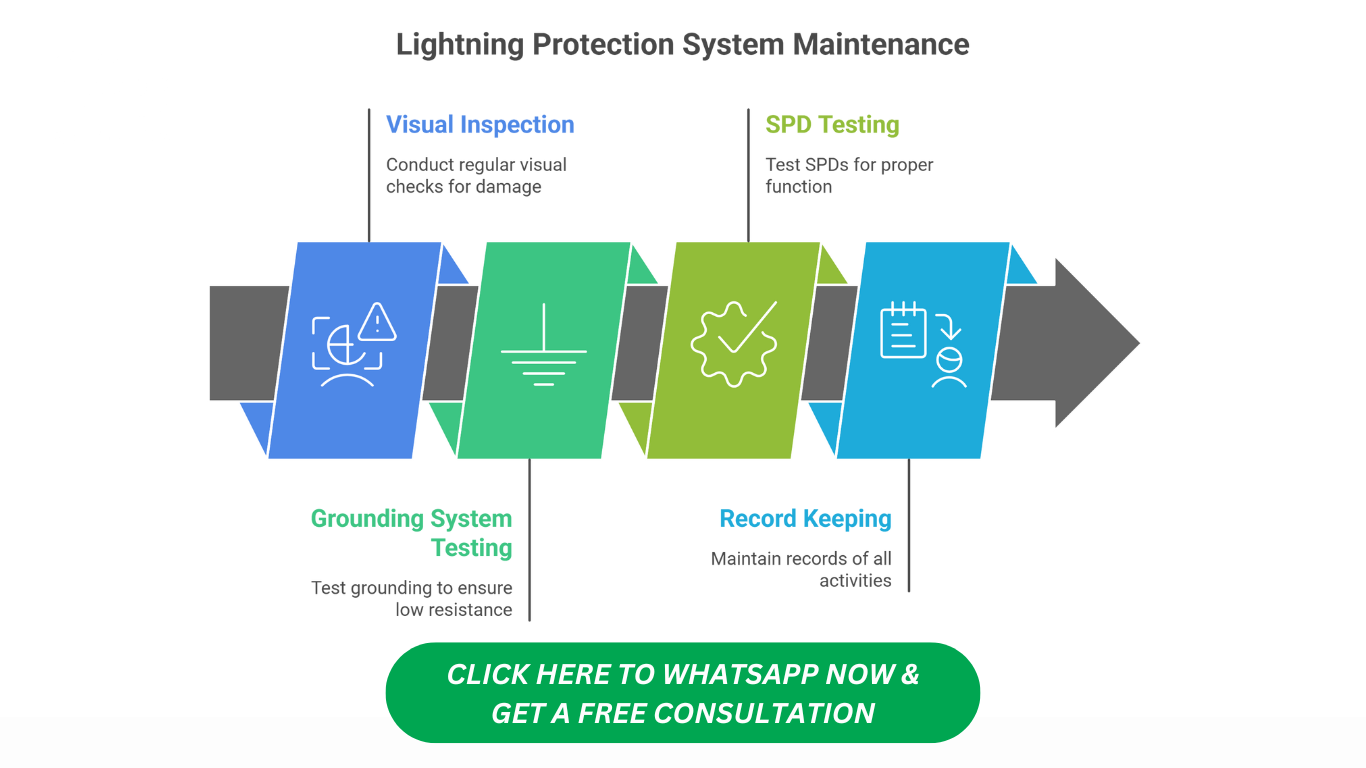
- Regular Inspection Schedules: Systems should be visually inspected semi-annually and undergo a comprehensive inspection annually, especially after any major storm.
- Ground Resistance Testing: The performance of the grounding system degrades over time due to soil corrosion and changing moisture content. Annual testing with a ground resistance tester is essential to ensure the system’s resistance remains within acceptable limits.
- Corrosion Management: Using compatible metals and corrosion-resistant connectors (e.g., bimetallic lugs) prevents the system from deteriorating and failing at the connections over time.
Common Pitfalls and How to Avoid Them
In our decades of field experience, we see the same mistakes repeated. Avoiding these common pitfalls is the difference between a system that looks good on paper and one that performs in a storm.
1. The Fatal Flaw: Poor Grounding
This is, without question, the number one failure point. A beautiful air terminal and a shiny new down conductor are a complete waste of money without a low-resistance connection to earth. Never underestimate the investment required in a proper grounding system; it is the foundation of all effective high mast lightning protection.
2. The Hidden Hazard: Ignoring Bonding
We cannot overstate this: the pole itself is not a reliable down conductor. Assuming the steel column will safely conduct the strike is a dangerous gamble. Failure to bond all metal components creates lethal side-flashing hazards and invalidates the protection scheme. Every ladder rung, every handhold, must be bonded.
3. The False Economy: Omitting SPDs
Thinking “the lightning rod will handle everything” is a costly error. Surge Protection Devices are your primary defense against the more frequent threat of induced surges that destroy electronics. Omitting SPDs to save a few hundred dollars per pole is an invitation for repeated, costly failures of ballasts and drivers.
4. Compromising on Quality: Using Substandard Materials
Undersized cables, non-listed connectors, and materials not suited for the environment will fail. The forces at play during a strike are immense. The high mast lightning protection system must be built with components that are listed for the purpose and designed to withstand decades of exposure.
5. The “Install and Forget” Fallacy: Neglecting Maintenance
Lightning protection is not a one-time event. Connections can loosen, grounds can degrade, and components can corrode. A proactive maintenance schedule is the only way to ensure your high mast lightning protection system remains in a ready state, year after year.
Case Study: A Municipal Solution for a Highway Interchange
The Problem: A midwestern city experienced repeated, costly failures of their high mast poles at a key highway interchange. After the third strike in two years, which knocked out lighting for a crucial cloverleaf and required a $15,000 repair per pole, they commissioned a forensic engineering review. The investigation revealed an incomplete high mast lightning protection system: while air terminals were present, the grounding was inadequate (a single ground rod in high-resistivity soil) and there were no SPDs installed.
The Solution: The city hired a specialist firm to retrofit all twelve poles at the interchange with a full NFPA 780 compliant high mast lightning protection system. The solution included:
- Upgraded air terminals and down conductors.
- A comprehensive bonding of all ladders and doors.
- A new low-resistance ground ring system, involving multiple interconnected rods with enhanced backfill material.
- The installation of both Type 1 (service entrance) and Type 2 (luminaire) Surge Protection Devices.
The Result: The project was completed within budget. In the three years since installation, the interchange has experienced numerous documented thunderstorms with significant lightning activity. The result? Zero lightning-related failures. The initial investment in a certified high mast lightning protection system has already paid for itself multiple times over, eliminating repair costs, crane rentals, and the significant public safety risk of darkened roadways.
Conclusion: An Investment in Safety and Reliability
Effective high mast lightning protection is not a single product but a holistic, engineered system. It seamlessly integrates structural interception (air terminals, down conductors) with robust grounding and internal electrical defense (SPDs). As we have outlined, every component, from the rod at the top to the ground ring below, plays a non-negotiable role.
Adhering to established standards like MS IEC62305 and partnering with experienced, certified professionals is the most reliable way to ensure your infrastructure—and the people who depend on it—are protected. Viewing high mast lightning protection as a capital investment rather than an expense reframes the decision. It is an investment in uptime, in public safety, and in the long-term fiscal responsibility of managing critical assets.
Don’t wait for a direct strike to reveal the weaknesses in your current setup. Be proactive.
Ready to secure your assets? Contact our team of certified lightning protection specialists today for a comprehensive site assessment. We ensure all our designs and installations meet the strictest MS IEC62305 standards for your absolute peace of mind.
FAQs: High Mast Lightning Protection
Why do high mast poles need specialized lightning protection?
High mast poles are often the tallest structures in an area, such as a highway interchange or sports complex, making them a natural target for lightning strikes. Without a dedicated, low-resistance path to ground, the immense energy from a strike can travel unpredictably, causing catastrophic damage to the pole’s structure, internal wiring, and expensive electrical components like ballasts and photocells.
Isn’t the steel pole itself sufficient to act as a lightning rod?
While the steel pole will conduct the strike, it is not a safe or complete protection system. Without a bonded down conductor and proper grounding, the current can “side-flash” to internal components like the ladder or wiring, causing severe damage and creating a fire hazard. A dedicated system, compliant with standards like MS IEC 62305, controls the path of the current from the air terminal directly to a grounding system, safely bypassing the critical internal parts.
How often should a high mast lightning protection system be inspected?
A visual inspection should be conducted at least annually. However, a more thorough inspection, including testing the resistance of the grounding system with specialized equipment, is recommended every 3 to 5 years, or after any known direct lightning strike. Regular maintenance ensures the system’s integrity hasn’t been compromised by corrosion or physical damage.
Disclaimer
The information provided in this blog is intended for general informational purposes only. Prices, specifications, and availability may vary depending on suppliers, location, and market conditions. Readers should verify details directly with suppliers or manufacturers before making purchasing decisions. The author and website are not responsible for any errors, omissions, or outcomes resulting from the use of this information. Always consult a professional for advice tailored to your specific needs.

