

In the high-stakes world of the oil and gas industry, the margin for error is non-existent. Among the various atmospheric hazards that industrial facilities face, lightning remains one of the most unpredictable and devastating. A single strike can trigger a catastrophic chain of events, leading to massive fires, environmental degradation, and the loss of human life. This is why a robust oil tank lightning protection strategy is not merely a recommendation—it is a critical operational necessity.
Statistical data from industrial safety organizations indicates that lightning is responsible for nearly 33% of all storage tank fires globally. When we consider the volatility of the substances stored within these vessels, the importance of expertise and authoritativeness in designing protection systems cannot be overstated. This blog provides a deep dive into the engineering, regulatory, and practical aspects of securing your assets.
TAKO since 1979 has over 25+ years of Experience in offering MS IEC 62305 Compliant Best Lightning Protection System in Malaysia.
Why You Should Choose TAKO Lightning Protection System Malaysia

1. The Physics of the Threat: Why Oil Tanks Are Targets
To implement effective oil tank lightning protection, one must first understand the physics of a lightning strike. Lightning seeks the path of least resistance to neutralize the potential difference between the clouds and the earth. Large, metallic structures like oil storage tanks are prime targets due to their height and conductivity.
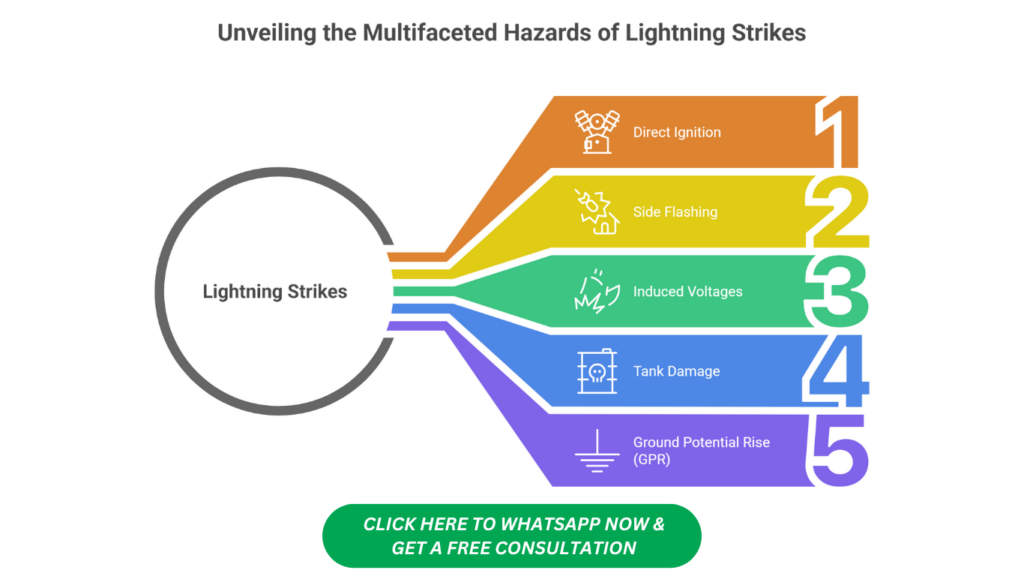
There are two primary ways lightning affects a tank:
- Direct Strikes: A direct hit to the tank shell or the roof. While the metal shell of a tank can often conduct the current to the ground, the heat generated at the point of impact can exceed 30,000 Kelvin, easily piercing thin roof plates or igniting flammable vapors.
- Indirect Strikes and Surges: A strike nearby can create a massive electromagnetic pulse (EMP) or “ground potential rise.” This induces currents in the tank’s wiring, sensors, and instrumentation, often leading to electronic failure or internal arcing.
Modern oil tank lightning protection must address both of these phenomena to ensure total facility integrity.
2. Regulatory Compliance: The Standards of Authority
Experience in the field teaches us that “guessing” is not a safety strategy. Authoritative bodies have established rigorous standards to guide the installation of oil tank lightning protection systems.
- NFPA 780: This is the benchmark standard for the installation of lightning protection systems in the United States. It provides specific chapters on the protection of structures containing flammable vapors and gases.
- API RP 2003: Published by the American Petroleum Institute, this Recommended Practice focuses on protection against ignitions arising from static, lightning, and stray currents. It is the “Bible” for safety engineers focusing on oil tank lightning protection.
- API RP 545: This standard specifically addresses the lightning protection of aboveground storage tanks. It was developed to fix the shortcomings of earlier standards, particularly regarding floating roof tanks where arcing between the roof and shell was a common cause of ignition.
Following these standards ensures that your facility is not only safe but also compliant with insurance requirements and federal safety audits.
3. The Anatomy of an Oil Tank Lightning Protection System
A comprehensive oil tank lightning protection system is comprised of several integrated components. It is a common misconception that a single lightning rod is sufficient. In reality, a holistic approach is required.
Air Terminals and Dissipation Systems
Conventional lightning rods (air terminals) are designed to “capture” the strike and funnel it to the ground. However, in volatile environments, many experts prefer Charge Transfer Systems (CTS). Instead of attracting the strike, these systems work on the principle of “streamer delay,” reducing the buildup of static charge on the tank and making a direct strike less likely to occur in the protected zone.
Down Conductors and Grounding
Once the lightning is intercepted, the current must be safely guided to the earth. The tank shell itself often acts as a natural conductor, but supplemental down conductors are frequently used in modern oil tank lightning protection designs to ensure a low-impedance path. The grounding system—consisting of ground rods, grids, or electrolytic electrodes—must be tested regularly to ensure resistance levels remain within safe parameters (typically below 10 ohms).
4. Addressing the Vulnerability of Floating Roof Tanks
Floating roof tanks (FRTs) present a unique challenge for oil tank lightning protection. Because the roof moves up and down based on the product level, there is a physical gap between the roof and the tank shell. This gap is usually filled with a seal, but the electrical bond between the roof and shell is often inconsistent.
During a lightning event, a “side-flash” or electrical arc can occur across this gap. If flammable vapors are present in the seal area, an immediate fire is almost guaranteed. To mitigate this, API 545 recommends:
- Submerged Shunts: These provide a permanent electrical bond between the roof and the shell, located below the liquid level to prevent any arcing from reaching the vapor space.
- Retractable Grounding Assemblies (RGA): These are spring-loaded cables that provide a constant, low-impedance connection between the roof and the tank shell, regardless of the roof’s position. Implementing RGAs is considered a “best practice” in high-end oil tank lightning protection setups.
5. Advanced Technology: Moving Toward Prevention
As technology evolves, so does the sophistication of oil tank lightning protection. We are moving away from the “Franklin Rod” era into an era of proactive prevention.
Dissipation Array Systems (DAS) are a prime example. By using thousands of sharp points to facilitate a “point discharge” effect, these systems slowly leak the ground charge into the atmosphere. This prevents the formation of an upward streamer, which is necessary for a lightning strike to complete its path. For critical infrastructure, this preventive approach to oil tank lightning protection offers a much higher degree of certainty than traditional methods.
6. Surge Protection for Instrumentation and Automation
Modern tank farms are highly automated, utilizing Radar Tank Gauging (RTG), pressure sensors, and automated valves. Even if your oil tank lightning protection system prevents a fire, an indirect strike can fry thousands of dollars worth of sensitive electronics.
Surge Protection Devices (SPDs) must be installed on all power and data lines entering and leaving the tank area. Without integrated surge suppression, your oil tank lightning protection is incomplete, leaving your “brain” (the control system) vulnerable while the “body” (the tank) is protected.
7. The Importance of Maintenance and Field Audits
Experience has shown that even the best oil tank lightning protection system will degrade over time. Corrosion is the primary enemy in oil and gas environments, particularly in coastal refineries where salt air accelerates the oxidation of copper and aluminum components.
A trustworthy maintenance program should include:
- Visual Inspections: Checking for loose connections, frayed bypass conductors, and corroded ground points.
- Continuity Testing: Using specialized meters to ensure that the electrical bond from the top of the tank to the grounding grid is unbroken.
- Soil Resistivity Testing: Ensuring that the ground remains capable of dissipating high-voltage current.
By maintaining a rigorous audit trail, facility managers demonstrate a commitment to safety and bolster the “Trustworthiness” pillar of their operations. Any failure in oil tank lightning protection can usually be traced back to a lack of maintenance rather than a failure of the technology itself.
8. Case Study: Why Every Second Matters
Consider an incident at a major storage terminal that lacked modern oil tank lightning protection. A summer storm produced a direct strike on a fixed-roof tank. Because the venting system was not properly protected and the grounding was degraded, the internal vapors ignited, resulting in a tank “blow-off.”
Post-incident analysis revealed that a relatively small investment in a modern oil tank lightning protection system—specifically updated air terminals and improved bonding—would have prevented a $15 million loss. This serves as a stark reminder that the cost of protection is a fraction of the cost of a disaster.
9. Developing a Lightning Risk Management Plan
Every site is different. A desert-based tank farm has different needs than a coastal refinery. A professional oil tank lightning protection strategy begins with a site-specific risk assessment. This assessment considers:
- The frequency of lightning in the geographic area (keraunic level).
- The type of product stored (flashpoint and volatility).
- The tank construction (material, roof type, and age).
- The proximity to other high-risk structures.
Only after this assessment can a customized oil tank lightning protection solution be engineered.
10. Frequently Asked Questions (FAQ)
Does a steel tank need a lightning rod if it is inherently grounded?
While a steel tank is a great conductor, the “self-protecting” myth is dangerous. Strikes can still pierce the shell or ignite vapors at vents. A dedicated oil tank lightning protection system provides a controlled path and prevents “hot spots” on the tank skin.
How often should I inspect my oil tank lightning protection components?
According to NFPA standards, a visual inspection should be done annually, with a comprehensive electrical test every 3 to 5 years. However, in highly corrosive environments, semi-annual checks are recommended.
Are bypass conductors really necessary for floating roofs?
Yes. Without bypass conductors or RGAs, the roof is electrically isolated from the shell. This creates a high risk of arcing. Modern oil tank lightning protection protocols practically mandate the use of RGAs for all floating roof assets.
Can lightning protection prevent 100% of strikes?
No system can claim 100% prevention. However, a professionally engineered oil tank lightning protection system can reduce the risk of damage and ignition to near-zero levels, providing the best possible defense for your facility.
Conclusion: Securing the Future of Energy Storage
In conclusion, the complexity of oil tank lightning protection requires a marriage of high-level engineering and practical field experience. By adhering to API and NFPA standards, investing in advanced dissipation technologies, and maintaining a rigorous inspection schedule, operators can significantly mitigate one of the industry’s most persistent threats.
Safety is an investment in the longevity of your business. As weather patterns become more volatile and global energy demands rise, ensuring your oil tank lightning protection is up to date is not just a regulatory hurdle—it is a cornerstone of responsible industrial leadership. Do not wait for the next storm to evaluate your defenses; the time to audit your oil tank lightning protection is now.
By prioritizing expertise and authoritativeness in your safety protocols, you protect your employees, your community, and your bottom line. Proper oil tank lightning protection is the silent sentinel that stands between a routine thunderstorm and a headline-making disaster.
Disclaimer
The information provided in this blog is intended for general informational purposes only. Prices, specifications, and availability may vary depending on suppliers, location, and market conditions. Readers should verify details directly with suppliers or manufacturers before making purchasing decisions. The author and website are not responsible for any errors, omissions, or outcomes resulting from the use of this information. Always consult a professional for advice tailored to your specific needs.

