
In the world of meteorology and urban safety, few places on earth command as much respect—and caution—as the state of Selangor, Malaysia. Often referred to as part of the “Lightning Capital of the World,” the Klang Valley, and specifically Selangor, faces a disproportionate amount of electrical atmospheric activity. For property managers, factory owners, and developers, a Selangor lightning risk assessment is not merely a box to tick on a compliance form; it is a critical life-saving protocol.
With an average of 240 to 300 thunderstorm days per year, the density of lightning strikes in areas like Subang Jaya, Shah Alam, and Petaling Jaya is staggering. This blog explores the technical, legal, and practical necessities of conducting a comprehensive Selangor lightning risk assessment to ensure your assets remain protected under the harshest tropical conditions.
TAKO since 1979 has over 25+ years of Experience in offering MS IEC 62305 Compliant Best Lightning Protection System in Malaysia.
1. Introduction: Why Selangor is the Lightning Capital
When we talk about lightning in Malaysia, we are talking about world-class intensity. According to data from the Malaysian Meteorological Department, the lightning flash density in Selangor is among the highest globally. While a typical temperate country might see 2 or 3 flashes per square kilometer per year, parts of Selangor can experience over 40.
This environmental reality means that the standard “lightning rod” approach used in other countries is insufficient here. A professional Selangor lightning risk assessment takes into account the unique topographical and meteorological challenges of the region. Whether you are managing a high-rise in the heart of Kuala Lumpur’s border or a sprawling manufacturing plant in Port Klang, understanding the specific risks associated with your geographic coordinates is the first step in engineering a resilient defense.
2. The Legal Framework: Suruhanjaya Tenaga (ST) & MS IEC 62305
In Malaysia, the regulatory landscape regarding lightning is clear. The Suruhanjaya Tenaga (Energy Commission) has issued strict directives regarding the installation and maintenance of Lightning Protection Systems (LPS). Central to these regulations is the adoption of the international standard, MS IEC 62305.
The Mandatory Nature of Compliance
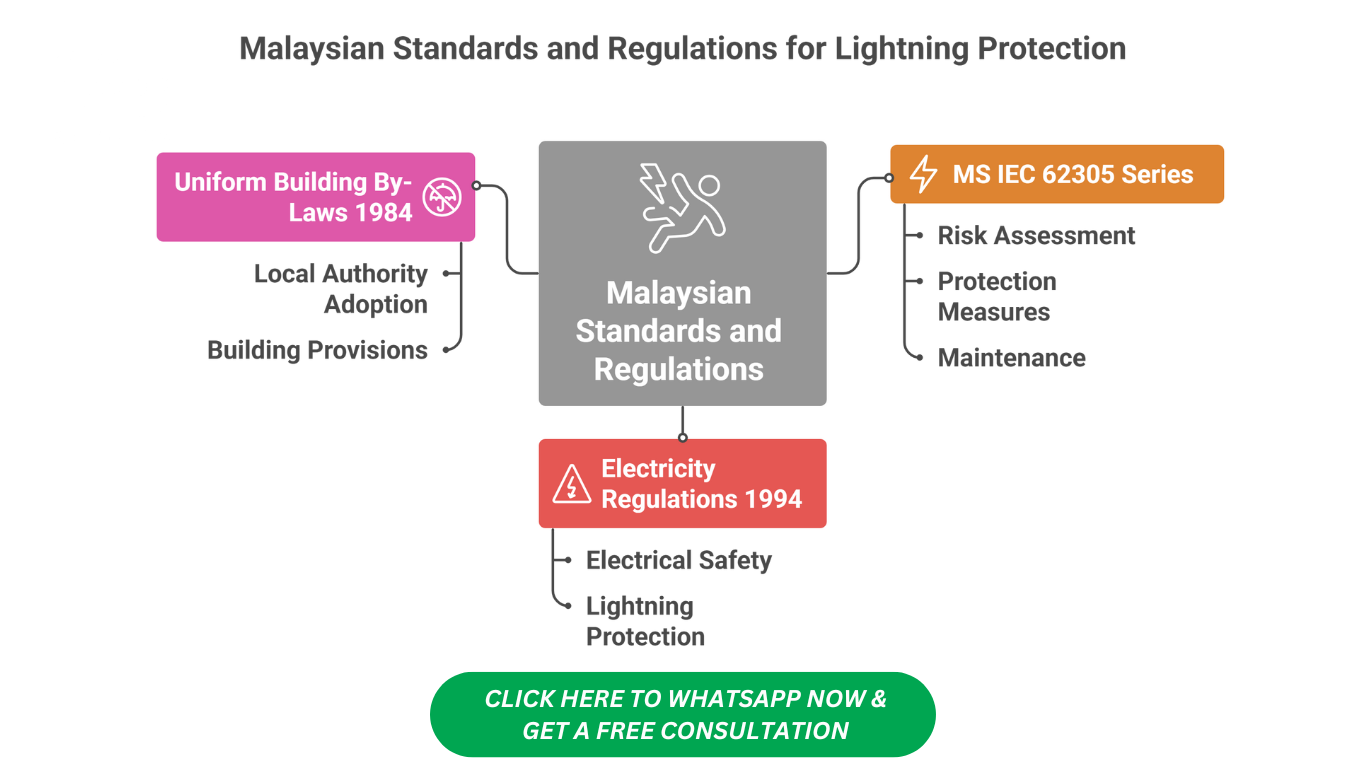
Under the Electricity Regulations 1994 and subsequent circulars, the Energy Commission mandates that all buildings must be protected against lightning in accordance with the MS IEC 62305 standard. If a facility manager fails to provide a documented Selangor lightning risk assessment during a safety audit, they risk not only heavy fines but also the voiding of fire insurance policies.
Breaking Down MS IEC 62305
The MS IEC 62305 is divided into four critical parts, all of which are analyzed during a Selangor lightning risk assessment:
- Part 1: General Principles: Understanding the properties of lightning and the parameters for simulation.
- Part 2: Risk Management: This is the “meat” of the assessment. It involves calculating the risks of loss of human life, loss of public services, and loss of economic value.
- Part 3: Physical Damage to Structures: Designing the “Faraday Cage” or the physical shield that intercepts the strike.
- Part 4: Electrical and Electronic Systems: Protecting the sensitive equipment inside the building from the electromagnetic pulse.
By following these standards, a Selangor lightning risk assessment ensures that the building is not just “protected,” but protected to a specific level of efficiency (Level I to IV) based on the calculated risk.
3. Why General Electricians Aren’t Enough
A common mistake made by many property owners is hiring a general electrical contractor to install a “lightning rod.” However, without a formal Selangor lightning risk assessment, this can lead to two dangerous outcomes:
- Under-Engineering: The system is too weak to handle the massive 200kA (kiloampere) surges common in Malaysian storms, leading to structural fires.
- Over-Engineering: The owner spends hundreds of thousands of Ringgit on a system that is far more complex than necessary because the risks weren’t properly calculated.
Experienced engineers know that lightning doesn’t just travel “down a wire.” It produces a massive electromagnetic field. If your Selangor lightning risk assessment doesn’t account for “Side Flashing”—where the lightning jumps from the conductor into the building’s internal steel reinforcement—the system could actually cause more harm than good.
Furthermore, Selangor’s soil varies significantly. From the peaty soils of Kuala Langat to the rocky terrain of Ulu Langat, the “Earthing” component of the system must be customized. A professional Selangor lightning risk assessment includes soil resistivity testing to ensure the lightning energy can actually enter the ground safely.
4. Critical Components of an Assessment Report
When you receive your final Selangor lightning risk assessment report, it should be a comprehensive document that serves as a roadmap for safety. It must include:
- Vulnerability Mapping: A 3D or 2D representation of the building’s roof, identifying the “Rolling Sphere” analysis results—basically showing where the lightning is most likely to touch.
- Surge Protection Evaluation (SPD): Most lightning damage in Selangor is indirect. A strike 500 meters away can send a surge through the power lines. The Selangor lightning risk assessment must specify exactly which Surge Protection Devices are needed at the Main Switchboard (MSB) and Sub-boards.
- Separation Distance Calculations: To prevent internal sparking, the assessment calculates the safe distance between the lightning conductors and any internal metal pipes or electrical wires.
- Maintenance Schedule: Lightning protection is not “set it and forget it.” In the corrosive, humid environment of Selangor, components can degrade. The Selangor lightning risk assessment will dictate how often the system needs to be tested (usually annually).
5. How to Choose a Qualified Consultant in Selangor
With the high stakes involved, you cannot afford to hire the wrong firm. To ensure you are getting a valid Selangor lightning risk assessment, use this checklist:
- ST Registration: Is the firm or the lead engineer registered with the Suruhanjaya Tenaga? This is non-negotiable for legal compliance in Malaysia.
- Software Utilization: Ask if they use specialized software (like StrikeRisk or similar IEC-compliant tools) to perform the calculations. Manual “estimates” are no longer acceptable for a Selangor lightning risk assessment.
- Local Knowledge: Ensure they understand the specific flash density maps of Selangor. A consultant from a low-risk country might not appreciate the sheer volume of energy they are trying to ground.
- Comprehensive Reporting: Does the consultant provide a detailed PDF report that can be submitted to insurers and the Fire Department (BOMBA)? A simple “letter of fit” is not a substitute for a Selangor lightning risk assessment.
By focusing on these points, you establish a “Trust” factor, knowing that your facility is backed by scientific data rather than guesswork.
6. Case Study: The Cost of Ignoring Risk in the Klang Valley
Imagine a manufacturing facility in Shah Alam. The owners decided to skip a professional Selangor lightning risk assessment because the building was “only two stories high.” They assumed the taller neighbor would protect them.
During a typical April monsoon, a “side flash” hit their HVAC system on the roof. Because there was no calculated surge protection in place, the current traveled through the ducting and fried the entire server room. The resulting downtime cost the company RM 500,000 in lost production, and the insurance claim was contested because the facility did not have a valid Selangor lightning risk assessment or a maintained LPS.
This scenario is common in Selangor. Investing in a proper Selangor lightning risk assessment is a fraction of the cost of a single day of lost operations.
7. Conclusion: Proactive Safety in a High-Risk Zone
Selangor is a beautiful, thriving hub of industry and culture, but its weather is unforgiving. As we move toward more sensitive digital infrastructure and smart buildings, the vulnerability to electrical atmospheric discharges only increases.
A Selangor lightning risk assessment is your first line of defense. It provides the mathematical certainty required to protect human life and expensive machinery. By adhering to MS IEC 62305 and the guidelines set by the Suruhanjaya Tenaga, you are not just following the law—you are building a culture of safety.
Don’t wait for the next monsoon season to find the weak points in your structure. Secure a professional Selangor lightning risk assessment today. It is the only way to ensure that when the next bolt hits, your building remains a safe haven in the “Crown of Lightning.”
Disclaimer
The information provided in this blog is intended for general informational purposes only. Prices, specifications, and availability may vary depending on suppliers, location, and market conditions. Readers should verify details directly with suppliers or manufacturers before making purchasing decisions. The author and website are not responsible for any errors, omissions, or outcomes resulting from the use of this information. Always consult a professional for advice tailored to your specific needs.

