

The Hidden Threat to Johor’s Industrial Powerhouse
Picture this: a typical afternoon in Johor Bahru. The tropical sky darkens rapidly, and within minutes, a spectacular lightning storm unleashes its fury. The thunder rattles windows across the Senai industrial estate. For a critical split-second, the lights in your factory flicker. When power stabilizes, your production line remains silent. A sophisticated PLC controlling your automated assembly line has been completely fried. What you’ve just experienced isn’t merely bad luck—it’s a catastrophic power surge event that could cost your factory hundreds of thousands in equipment damage, production downtime, and lost orders.
In Johor’s thriving industrial landscape—spanning from Pasir Gudang to Tanjung Langsat—this scenario plays out more frequently than most factory owners realize. Surge protection for factory Johor operations isn’t a luxury or an afterthought; it’s an essential component of operational resilience and financial prudence. Malaysia experiences between 180 to 260 thunderstorm days annually, with Johor consistently ranking among regions with high lightning density. Combine this environmental reality with TNB’s complex grid infrastructure and the internal electrical dynamics of large manufacturing facilities, and you have a perfect storm of surge vulnerability.
This blog will walk you through why surge protection for factory Johor facilities requires specialized attention, how to implement a robust protection strategy, and what specific considerations apply to our unique regional context. Whether you operate in plastics manufacturing in Plentong, electronics in Senai, or heavy industry in Tanjung Langsat, understanding and implementing proper surge protection for factory Johor installations could mean the difference between uninterrupted productivity and catastrophic operational failure.


Protect Your Factory from Johor’s Lightning & Power Surges
Avoid costly downtime, PLC failures, and equipment damage. Get a professional site assessment tailored for your facility.
Claim FREE Site Visit (Worth RM380)Section 1: Understanding the Surge Threat Landscape in Johor
What Exactly Is a Power Surge?
Think of your factory’s electrical system as a sophisticated network of pipes carrying electrical current. Under normal conditions, water flows at a consistent, controlled pressure (220-240V in single-phase, 415V in three-phase systems). A power surge is essentially a massive tidal wave—a brief but extreme spike in voltage that can reach thousands of volts, lasting from microseconds to a few milliseconds. This “electrical tsunami” crashes through your delicate electronic components, overwhelming their designed tolerances and causing immediate or cumulative damage.
The Triple Threat: Why Johor Factories Face Unique Vulnerabilities
When planning surge protection for factory Johor facilities, you must address three distinct sources of surges:
1. Environmental Surges: Johor’s Thunderstorm Reality
Johor’s equatorial climate brings predictable afternoon thunderstorms, particularly during inter-monsoon periods. The Malaysian Meteorological Department notes that Johor experiences lightning flashes at densities of 10-20 flashes per square kilometer annually—some of the highest in Peninsular Malaysia. Each lightning strike, whether direct or within kilometers of your facility, induces electromagnetic pulses that travel through power lines, data cables, and even structural elements.
2. Grid-Generated Surges: The TNB Factor
Our national power infrastructure, while generally reliable, creates its own surge challenges:
- Capacitor Bank Switching: TNB regularly switches capacitor banks to regulate power factor and voltage levels across the grid. Each switching operation creates transient overvoltages that propagate through the network.
- Load Dumping: When large neighboring factories in industrial estates like Pasir Gudang suddenly shut down heavy equipment, the released energy surges back into the grid.
- Fault Clearing: When TNB isolates a fault elsewhere in the system, the sudden redirection of power creates switching surges that affect all connected facilities.
3. Internal Factory Surges: Your Own Worst Enemy
Ironically, the most frequent surge source originates within your own facility:
- Inductive Load Switching: The starting and stopping of large motors (conveyor systems, compressors, HVAC), welding equipment, and heavy machinery creates “back EMF” surges.
- Capacitive Bank Operations: Your own power factor correction systems, if not properly coordinated, can generate switching transients.
- Arcing Events: Worn contacts in breakers, relays, and switches create micro-arcs that generate high-frequency noise and surges.
The Real Cost: Beyond Equipment Replacement
When considering surge protection for factory Johor operations, factory managers often focus on direct equipment replacement costs. The true financial impact is substantially broader:
- Direct Equipment Damage: Sensitive electronic controllers are particularly vulnerable. Replacement costs for:
- PLC systems: RM 5,000 – RM 50,000+
- Variable Frequency Drives (VFDs): RM 3,000 – RM 30,000+
- CNC machine controllers: RM 20,000 – RM 200,000+
- Servo drives and position controllers: RM 2,000 – RM 25,000 each
- Production Downtime: This is typically the largest cost. A 24-hour shutdown of an automated production line can easily exceed RM 100,000 in lost output, missed deadlines, and penalty clauses.
- Data Corruption and Loss: Modern manufacturing equipment stores parameters, recipes, and production data. Surges can corrupt this data, requiring hours or days to reconstruct.
- Secondary Damage: A surge-damaged motor drive can cause mechanical stress or failure in connected equipment.
- Warranty Voidance: Many equipment manufacturers void warranties if damage results from inadequate surge protection.
This multi-layered threat landscape makes comprehensive surge protection for factory Johor installations not just advisable but essential for business continuity.
Section 2: The Tiered Defense Strategy: Building Your Surge Protection Framework
Effective surge protection for factory Johor facilities follows a “defense-in-depth” philosophy, implementing multiple layers of protection at strategic points throughout your electrical system. This approach, standardized in IEC 62305, ensures that no single point of failure can compromise your entire operation.
The Foundation: Understanding Protection Levels (Types)
International standards categorize surge protective devices (SPDs) into three types based on their installation location and protective role:
Type 1 (Class I) SPDs: Designed to handle the very largest surges, particularly direct or nearby lightning strikes. These are installed at the service entrance where power enters your building.
Type 2 (Class II) SPDs: The workhorses of surge protection, handling the majority of surges from switching operations and induced lightning effects. Installed at distribution boards.
Type 3 (Class III) SPDs: Point-of-use devices providing fine protection for particularly sensitive equipment. Installed very close to the protected equipment.
Implementing the Three-Zone Protection Model
Zone 1: Service Entrance Protection (Your First Line of Defense)
Location: Main Distribution Board (MDB), immediately after the TNB meter and main breaker.
Purpose: To arrest the largest external surges before they penetrate your facility’s electrical system. This is non-negotiable for proper surge protection for factory Johor installations.
Technical Specifications to Demand:
- Lightning Current Impulse (Iimp): Minimum 25kA per phase (8/20μs wave), with 50kA+ recommended for Johor’s high lightning areas
- Voltage Protection Level (Up): ≤ 4kV for 415V systems
- Technology: Typically spark gap or hybrid spark gap/MOV technology
- Follow Current Interrupting Rating: Must exceed TNB’s prospective short-circuit current at your location
Johor-Specific Consideration: Factories with overhead service entrances (common in older industrial areas) require more robust Type 1 protection than those with underground feeds.
Zone 2: Sub-Distribution Protection (Internal Coordination)
Location: All Sub-Distribution Boards (SDBs) feeding different plant areas—production floor, packaging area, administration block, etc.
Purpose: To further reduce surge voltages to safer levels and protect individual distribution circuits. This layer is crucial for comprehensive surge protection for factory Johor facilities with multiple buildings or large floor areas.
Technical Specifications:
- Nominal Discharge Current (In): 20kA minimum (8/20μs wave)
- Voltage Protection Level (Up): ≤ 2.5kV
- Technology: Metal Oxide Varistor (MOV) based
- Thermal Protection: Essential—MOVs can fail short-circuit; proper devices include thermal disconnectors
Installation Insight: For large factories, coordinate Zone 1 and Zone 2 SPDs so the Zone 2 devices don’t attempt to handle surges beyond their capacity.
Zone 3: Point-of-Use Protection (Equipment-Specific Safeguards)
Location: Directly at or inside the control panels of sensitive equipment. This is where surge protection for factory Johor facilities most often falls short.
Critical Protection Points:
- PLC and Automation Panels: Every PLC rack should have dedicated protection
- VFD and Motor Controller Cabinets: Both power and control lines need protection
- CNC and Precision Machinery: These high-investment items warrant individual protection
- Communication Networks: Ethernet switches, fieldbus systems (Profibus, DeviceNet), and serial communication lines
- Measurement and Instrumentation: SCADA systems, sensors, weighing systems
Technical Specifications:
- Voltage Protection Level (Up): ≤ 1.5kV
- Response Time: <1ns for data line protection
- Interface-Specific Designs: RJ45 for Ethernet, RS-485 for serial, etc.
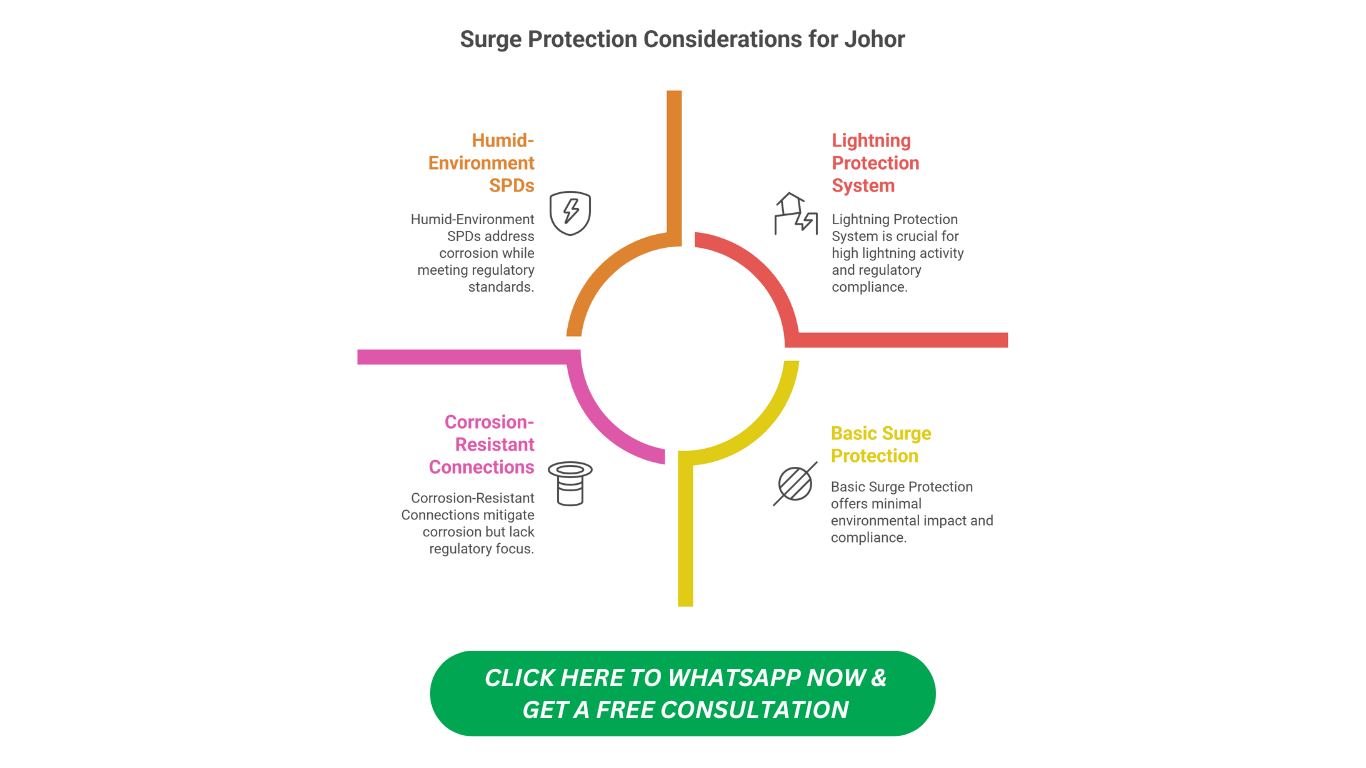
Johor Implementation Note: In our humid environment, ensure point-of-use SPDs are properly rated for industrial environments (IP20 minimum, with IP54 recommended for dusty or washdown areas).
Section 3: Implementation Guide: From Assessment to Maintenance
Step 1: The Critical Risk Assessment
Proper surge protection for factory Johor implementation begins with a thorough risk assessment—this is not a DIY exercise. Engage with qualified electrical engineers who understand both international standards and local conditions. A proper assessment should include:
- Single-Line Diagram Review: Mapping your entire electrical distribution system
- Equipment Audit: Identifying all sensitive electronic equipment with replacement costs and downtime implications
- Site Evaluation: Assessing lightning exposure (building height, location, neighboring structures)
- Grounding System Analysis: The foundation of all surge protection
- Historical Data Review: Documenting previous surge-related failures
Red Flag: Any vendor proposing SPDs without conducting this assessment lacks the expertise for proper surge protection for factory Johor implementations.
Step 2: Specification and Product Selection
When selecting SPDs for your surge protection for factory Johor system, demand these minimum specifications:
For Type 1 (Service Entrance):
- Compliance: MS IEC 61643-11 / IEC 61643-11
- Iimp: ≥ 25kA (12.5kA in L-N, 12.5kA in N-PE) per mode
- Uc (Max Continuous Operating Voltage): ≥ 440V for 415V systems
- Up: ≤ 4kV
For Type 2 (Distribution):
- In: ≥ 20kA per mode
- Uc: ≥ 440V
- Up: ≤ 2.5kV
- Thermal disconnection included
For Type 3 (Point-of-Use):
- Up: ≤ 1.5kV
- Specific coordination with upstream SPDs
- Appropriate interfaces for protected equipment
Brand Selection Considerations:
- Choose brands with established local support in Johor
- Verify SIRIM certification for Malaysian market
- Request references from similar industrial installations in Johor/Pasir Gudang/Senai
Step 3: Installation Best Practices (Where Many Johor Installations Fail)
Even the best SPDs underperform if installed incorrectly. Key installation principles for effective surge protection for factory Johor systems:
The Short Connection Rule:
SPD connections must be as short and straight as possible. Every 10cm of additional wire increases the let-through voltage by approximately 10V per amp. Use:
- Maximum 50cm total connection length (both line and ground sides)
- No looping or coiling of connection wires
- Preferably direct mounting on DIN-rail with integrated disconnect
Grounding System Integrity:
Your SPD system is only as good as your grounding. Ensure:
- Low impedance earth connection (<0.5Ω recommended for industrial)
- Proper bonding between all ground points
- Ground conductors sized appropriately (minimum 16mm² for Type 1, following MS IEC 60364)
Coordination Between SPD Levels:
Ensure Zone 2 SPDs don’t activate before Zone 1 devices. Proper manufacturers provide coordinated SPD families with documented coordination.
Local Compliance: All installations must comply with:
- Electricity Supply Act 1990
- MS IEC 60364 (Electrical Installations for Buildings)
- Guidelines from Suruhanjaya Tenaga
Step 4: Maintenance and Monitoring Protocols
SPDs are sacrificial devices—they degrade with each surge event. A maintenance program is essential for reliable surge protection for factory Johor systems:
Visual Indicators: Most SPDs include:
- Green/Red status windows
- Remote signaling contacts for connection to building management systems
Recommended Maintenance Schedule:
- Monthly: Visual check of all status indicators
- After Major Lightning Storms: Immediate inspection
- Annual: Comprehensive testing by qualified personnel, including earth resistance measurement
- Every 5 Years or When Indicated: Replacement of SPD modules (MOVs have finite energy absorption capacity)
Johor-Specific Maintenance Note: Our high humidity accelerates corrosion. Regularly check connection tightness and corrosion on terminals.
Section 4: Addressing Johor-Specific Concerns and Objections
Common Misconceptions About Surge Protection for Factory Johor Facilities
“We have lightning rods, so we’re protected.”
Lightning Protection Systems (LPS) and surge protection address different threats. LPS protects the building structure from direct strikes and fire. SPDs protect the electrical and electronic systems inside. You need both for complete protection. This distinction is crucial for proper surge protection for factory Johor facilities.
“We’ve never had a surge problem before.”
Surge damage is often cumulative. A device may withstand 99 small surges before failing on the 100th. Additionally, modern equipment with smaller semiconductor geometries is more vulnerable than older electromechanical systems. Proactive surge protection for factory Johor installations prevents the “first” catastrophic failure.
“Surge protectors are too expensive for our operation.”
Let’s analyze the ROI: A comprehensive surge protection for factory Johor system for a medium-sized factory might cost RM 15,000 – RM 50,000 installed. Compare this to:
- Replacement of one CNC controller: RM 40,000 – RM 150,000
- 24 hours of production downtime: RM 50,000 – RM 500,000+
- Data recovery and reprogramming: RM 5,000 – RM 20,000
The protection system often pays for itself in preventing a single incident.
“Can’t we just use power strips with surge protection?”
Consumer-grade power strips (typically <5kA rating) are completely inadequate for industrial environments. They’re designed for office equipment, not for the surge energy present in industrial settings. Proper surge protection for factory Johor requires engineered systems, not retail products.
Finding Qualified Professionals in Johor
The market for electrical services in Johor varies widely in quality. When seeking expertise in surge protection for factory Johor implementation, look for:
- Certifications: CWEG (Class A or B), Suruhanjaya Tenaga licensed, manufacturer-certified installers
- Experience: Specific experience with industrial (not just residential/commercial) SPD installations
- Design Capability: Ability to provide single-line diagrams with SPD placement and specifications
- Testing Equipment: Ownership of earth resistance testers, insulation testers, and surge testing equipment
- Local References: Ask for and contact references from factories of similar size and industry in Johor
Red Flags to Avoid:
- Contractors who propose “one-size-fits-all” solutions
- Those unable to explain coordination between SPD levels
- Companies without proper test equipment
- Quotations without detailed risk assessment or system design
Section 5: Advanced Considerations for Specific Johor Industries
Electronics Manufacturing (Senai, Skudai)
- Special Concern: Electrostatic discharge (ESD) and surge protection coordination
- Recommendation: Isolated power conditioners combined with SPDs for cleanroom equipment
- Data Line Protection: Critical for automated testing equipment and PCB assembly machines
Food and Beverage Processing (Pasir Gudang, Tanjung Langsat)
- Special Concern: Washdown environments and corrosion
- Recommendation: IP66 rated enclosures for SPDs in processing areas
- Focus Areas: Refrigeration compressor controls, automated packaging lines
Plastic Injection Molding (Plentong, Tebrau)
- Special Concern: Frequent cycling of large heater banks and hydraulic pumps
- Recommendation: Additional protection for temperature controllers and hydraulic power units
- Maintenance: Monthly inspection due to vibration from machinery
Automotive and Aerospace (Senai, Seelong)
- Special Concern: Precision machining equipment and robotic systems
- Recommendation: Fiber optic isolation for communication networks where possible
- Investment Priority: Highest level of protection for multi-axis CNC and CMM equipment
Conclusion: Building Surge Resilience into Your Johor Operation
Implementing comprehensive surge protection for factory Johor facilities represents one of the highest-return investments in operational resilience you can make. In our region’s unique electrical environment—characterized by frequent thunderstorms, grid complexities, and demanding industrial processes—leaving surge protection to chance amounts to gambling with your production capability and financial stability.
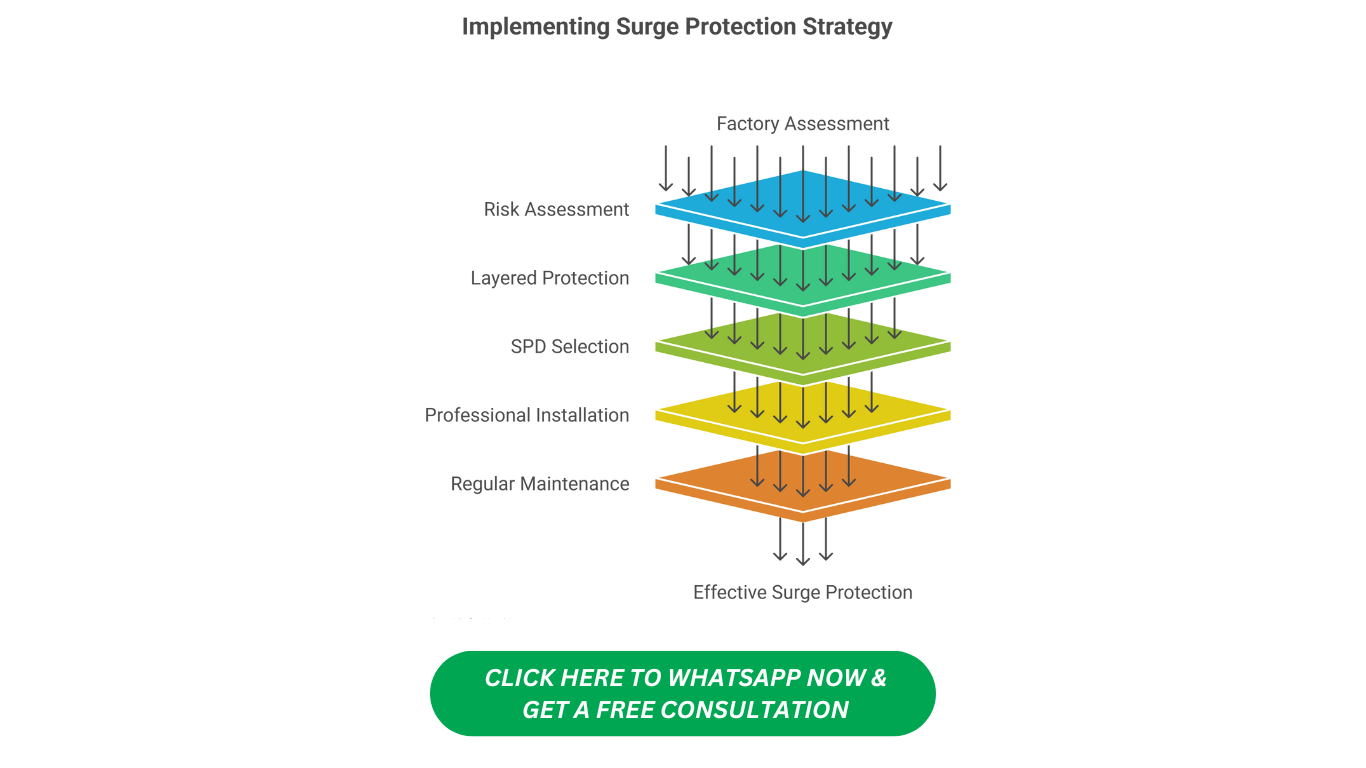
The journey to complete surge protection begins with acknowledgment: accepting that surge events aren’t random acts of nature but predictable occurrences that can be systematically mitigated. From there, it progresses through assessment, systematic implementation of a tiered protection strategy, proper installation, and ongoing maintenance.
As Johor continues to grow as Malaysia’s industrial powerhouse, the factories that thrive will be those that have hardened their operations against preventable disruptions. Your surge protection system functions as an insurance policy that not only protects but pays dividends through uninterrupted operations, extended equipment life, and preserved data integrity.
Your Next Step: Begin with a professional surge risk assessment. Document your current vulnerability and develop a phased implementation plan that addresses your most critical assets first. Remember that effective surge protection for factory Johor operations is not a product you buy but a system you implement—one that requires expertise, proper design, and quality installation.
For factories across Johor—from the chemical plants of Pasir Gudang to the tech manufacturers of Senai—robust surge protection has transitioned from optional safeguard to operational necessity. In the competitive landscape of Malaysian manufacturing, your resilience against electrical disturbances may well become your competitive advantage.
Disclaimer
The information contained in this blog is for informational and marketing purposes only and should not be taken as professional advice. Our focus is on providing comprehensive LPS total solution services. This service encompasses a wide range of solutions, including design, installation, and maintenance of a comprehensive lightning protection system tailored to your specific needs. For any questions or to discuss your specific lightning protection needs, please contact us directly.
TAKO’s Credentials


FAQ: Surge Protection for Factory Johor
Can’t we just use standard power strips with “surge protection” for our sensitive machines?
No. Consumer-grade power strips are completely inadequate for industrial environments. They are typically rated for less than 5kA and are designed for office electronics. The surge energy present in a factory setting, especially in Johor’s high-lightning climate, can be 10-100 times greater. Proper surge protection for factory Johor facilities requires engineered Type 2 and Type 3 SPDs that are coordinated with your electrical system and can handle industrial-level threats.
What’s the most common source of surges that damage factory equipment in Johor?
While lightning is a major threat, the most frequent and damaging surges actually originate inside your own facility. The switching of large inductive loads—like motors, compressors, and welding machines—generates powerful transients that travel back through your plant’s wiring. This is why internal surge protection for factory Johor installations at sub-panels and machine control points is just as critical as protection at the main service entrance.
What should we look for when choosing a contractor for surge protection in Johor?
Look for a licensed electrical contractor with specific industrial experience. They should:
Conduct a thorough on-site risk assessment (not just give a product quote).
Provide a single-line diagram showing SPD placement.
Use products from reputable brands with local warranty/support.
Explain the coordination between protection levels (Type 1, 2, and 3 SPDs).
Proper surge protection for factory Johor implementation is about system design, not just product sales. Always ask for references from similar industrial clients in the Johor area.

