
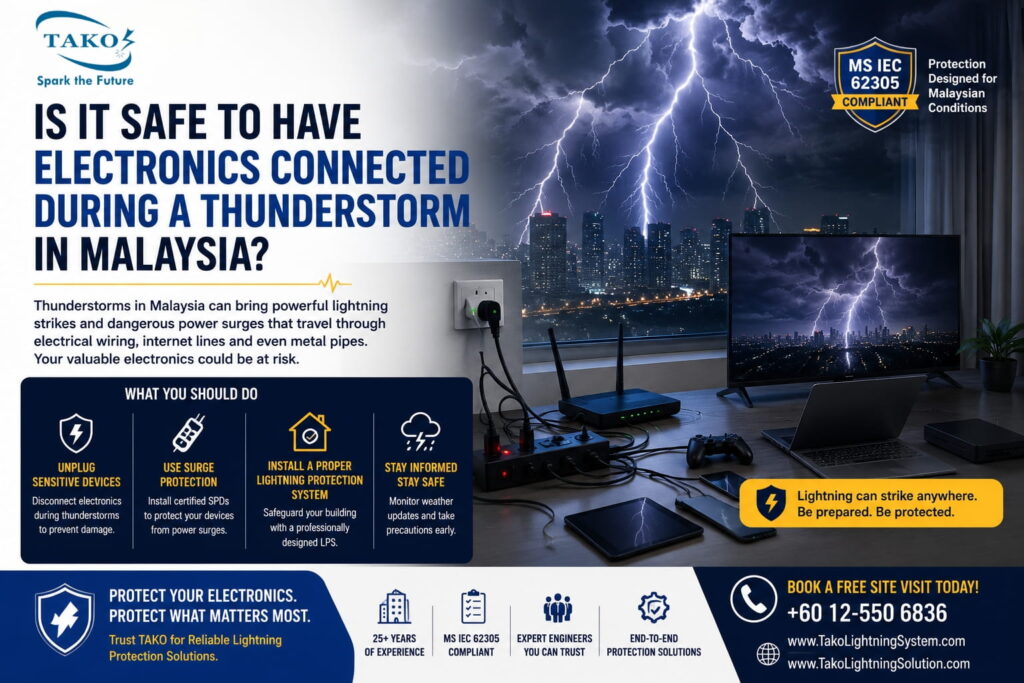
Is It Safe to Have Electronics Connected When It’s Thundering in Malaysia?
Plus: which surge protectors should you actually be using? Malaysia’s leading lightning specialist answers the questions Malaysians are Googling — and the ones they’re asking on Reddit.
No — it is not fully safe to keep electronics connected during a thunderstorm in Malaysia, one of the world’s highest lightning-density countries. Even without a direct lightning strike, powerful voltage surges can travel through your home’s power lines and destroy connected devices instantly. The single most effective protection is a proper IEC 61643-compliant Surge Protection Device (SPD) installed at your distribution board — and as a backup habit, unplug high-value electronics when a severe storm is approaching.
Why Malaysia Is One of the Most Lightning-Dangerous Countries on Earth
Understanding your actual risk level before deciding what surge protection you need.
Malaysia sits within the equatorial thunderstorm belt and records an average of 200+ thunderstorm days per year — with Klang Valley ranking among the world’s highest lightning flash density zones. According to TAKO Lightning System, an estimated RM250 million in losses occur annually in Malaysia from lightning damage across SMEs and industries alone.
For Malaysian homeowners and office workers, this translates to one clear reality: every thunderstorm is a live surge threat to every electronic device in your building.
⚡ Malaysia Thunderstorm Risk Scale
How Lightning Actually Destroys Your Electronics
It doesn’t need to strike your house directly. Here’s what really happens.
This is the part most Malaysians miss. You don’t need a direct lightning strike to lose your TV, router, refrigerator, or laptop. There are three main surge entry paths into your home during a thunderstorm:
When lightning strikes a power pole or transmission line nearby, a massive voltage spike (tens of thousands of volts) is injected directly into the low-voltage distribution grid. This surge rides straight through your TNB meter and into every socket in your home — in microseconds. Standard circuit breakers and fuses cannot react fast enough to stop it. The surge fries anything plugged in.
Coaxial cables (Astro), fibre ONT units, RJ45 data ports, and antenna cables are all external conductors entering your home. A nearby lightning strike induces strong electromagnetic pulses in these cables — destroying routers, modems, Astro decoders, CCTV DVRs, and network switches at the other end. This is why Unifi and Astro equipment failures spike dramatically after every major storm season in Malaysia.
When lightning discharges into the ground — either via a direct strike or through a poorly designed earthing system — it raises the local ground voltage dramatically. Equipment connected to both mains power and a separate grounding point can experience a destructive voltage difference across its circuits. This is a major cause of CCTV and industrial equipment losses in Malaysia.
Quick Quiz: How Storm-Safe Is Your Home Right Now?
Test your knowledge on lightning surge safety — many Malaysians get these wrong.
Your Storm-Safety Score
Which Surge Protectors Should You Use in Malaysia?
Breaking down the three SPD types — what the Reddit thread was really asking about.
The Reddit r/malaysia thread that sparked this post asked simply: “which/what surge protectors should I be looking out for?” The honest answer is that most Malaysians are using the wrong type — or none at all. Here’s how the three IEC 61643-defined SPD classes break down for a Malaysian home or office:
| SPD Type | Installed Where? | What It Stops | Suitable For | Compliance | TAKO Offers? |
|---|---|---|---|---|---|
| Type 1 | Main Distribution Board (incoming TNB supply) | Direct lightning strike currents (up to 25kA+) | Terrace houses, bungalows, factories, commercial lots | IEC 61643-11 Class I | ✓ Telebahn SPD |
| Type 2 Best for Most | Sub-distribution boards, floor panels, office DB | Indirect surges, switching transients (TNB fluctuations) | Apartments, condos, offices, SMEs — ideal everyday choice | IEC 61643-11 Class II | ✓ Telebahn SPD |
| Type 3 | At the socket / power strip level | Residual low-energy surges reaching equipment | Computers, home theatre, gaming PCs — last line of defence | IEC 61643-11 Class III | ✓ Telebahn SPD |
During a Thunderstorm in Malaysia: What To Do & What Not To Do
- Do: Keep IEC 61643-compliant SPDs permanently installed at your DB box — they work 24/7 without you needing to do anything during a storm.
- Don’t: Rely on a standard circuit breaker or MCB to stop lightning surges — breakers protect against overcurrent faults, not nanosecond-fast transient spikes.
- Do: Unplug high-value electronics (desktop PCs, NAS drives, home theatre amps) when a severe thunderstorm is approaching — still the simplest backup protection.
- Don’t: Assume your condo’s lightning rod covers your electronics. The structural LPS and your internal surge protection are two different systems. See: lightning arrester for home cost Malaysia.
- Do: Ensure your earthing system is properly installed and tested. A faulty earth can make surge damage worse. Read: earthing system in Malaysia explained.
- Don’t: Leave Astro, Unifi ONT, or CCTV plugged in without data-line surge protection — coaxial and RJ45 cables are a major surge entry path that power-only SPDs don’t cover.
- Do: Verify any SPD you buy carries IEC 61643 certification. Many cheap products claim surge protection without certified testing. TAKO’s Telebahn SPD range is IEC 61643-compliant and TUV-certified.
- Don’t: Skip the earthing rod installation — without a proper earth termination system, your SPD has nowhere to safely discharge the surge energy.
Why Malaysians Choose TAKO for Surge & Lightning Protection
Established 1979. Malaysia’s most awarded lightning specialist with 36 certified inventions.
Years of Lightning Expertise
TAKO has been protecting Malaysian homes, factories, and commercial buildings from lightning damage since 1979 — longer than most competitors have existed.
Sole Telebahn SPD Distributor
TAKO is Malaysia’s exclusive distributor of Telebahn Surge Protection Devices — IEC 61643-compliant, TUV-certified SPDs for power and data lines.
Free Site Visit (Worth RM380)
Every client gets a free on-site assessment — no sales pressure, just a professional evaluation of your lightning and surge risk by a certified engineer.
IEC 62305 & 61643 Compliant
All TAKO systems meet the Malaysian Standard for lightning protection and IEC 61643 for SPDs — accepted by DOSH, BOMBA, and insurers nationwide.
In Losses Prevented
TAKO’s total solution approach has helped Malaysia’s SME and industrial sectors avoid an estimated RM250 million in annual lightning-related damage.
Certified Inventions
Malaysia’s first proprietary Lightning Risk Assessment Software. SME100 Fast Moving Companies 2022. Multiple engineering awards for lightning protection innovation.
Frequently Asked Questions
Common questions from Malaysian homeowners and office managers about thunderstorm safety and surge protection.
Yes, if you don’t have an IEC 61643-compliant SPD installed at your DB box. A surge travelling through your power outlet can destroy a laptop’s motherboard or charging circuit in a fraction of a second. The safest approach is a proper Type 2 SPD at your distribution board as a permanent measure, combined with unplugging irreplaceable devices during severe storms as a backup habit.
This is extremely common in Malaysia and is caused by surges entering through the fibre ONT or RJ45 data port — not just the power cable. The solution is a two-part approach: (1) a Type 2 SPD at your DB box for power-line protection, and (2) a dedicated data-line SPD on your incoming internet or Astro line. Telebahn offers IEC 61643-compliant signal SPDs for exactly this. Learn more: lightning protection standards in Malaysia.
Generally, no. Most budget power strips sold in Malaysian hardware shops use a basic MOV component with no IEC 61643 compliance, no certified clamping voltage rating, and minimal energy absorption. They may handle minor electrical fluctuations but will fail instantly against a real lightning-induced surge. Only IEC 61643-certified Type 2 or Type 3 SPDs provide genuine protection for your electronics.
Partially. The external lightning protection system (rod + conductors + earthing) protects the building structure from a direct hit. However, it does not stop voltage surges entering through power lines, phone lines, or data cables. Most condominiums have the external LPS but leave unit owners responsible for their own internal surge protection.
For DB-level whole-house protection, Telebahn — exclusively distributed in Malaysia by TAKO — is the benchmark for IEC 61643-compliant, TUV-certified SPDs. For Type 3 socket-level protection, look for products that explicitly state IEC 61643-11 Class III compliance and a clamping voltage of 1,500V or lower. Avoid products that only cite “surge protection” as a marketing claim without a certification reference.
A properly installed earthing system should measure 10 ohms or below at the earth electrode. If your system has never been tested, or was installed more than 4 years ago without inspection, it may have degraded — especially in Malaysia’s humid, laterite soil conditions. TAKO provides earthing resistance testing and can recommend advanced rod earthing installation where needed.
Protect Your Electronics Before the Next Storm Season Hits
Get a FREE site assessment worth RM380 from TAKO’s certified lightning specialist team. We’ll evaluate your surge risk and recommend the exact IEC 61643-compliant SPD combination your property needs.
Further Reading from TAKO Lightning System
Deepen your understanding of lightning and surge protection in Malaysia.

