

Lightning is one of nature’s most unpredictable and destructive forces. For industries dealing with high-value assets—like telecommunications, oil and gas, or power distribution—a single direct strike can result in millions of dollars in equipment damage, data loss, and even life-threatening fires.
While traditional rooftop lightning rods work for standard buildings, they aren’t always enough for complex industrial sites or sensitive infrastructure. That is where a mast lightning protection system comes into play.
In this deep-dive blog, we will explore why a mast lightning protection system is the gold standard for high-risk environments, how they are engineered, and the specific steps required for professional-grade installation.
TAKO since 1979 has over 25+ years of Experience in offering MS IEC 62305 Compliant Best Lightning Protection System in Malaysia.


What Exactly is a Mast Lightning Protection System?
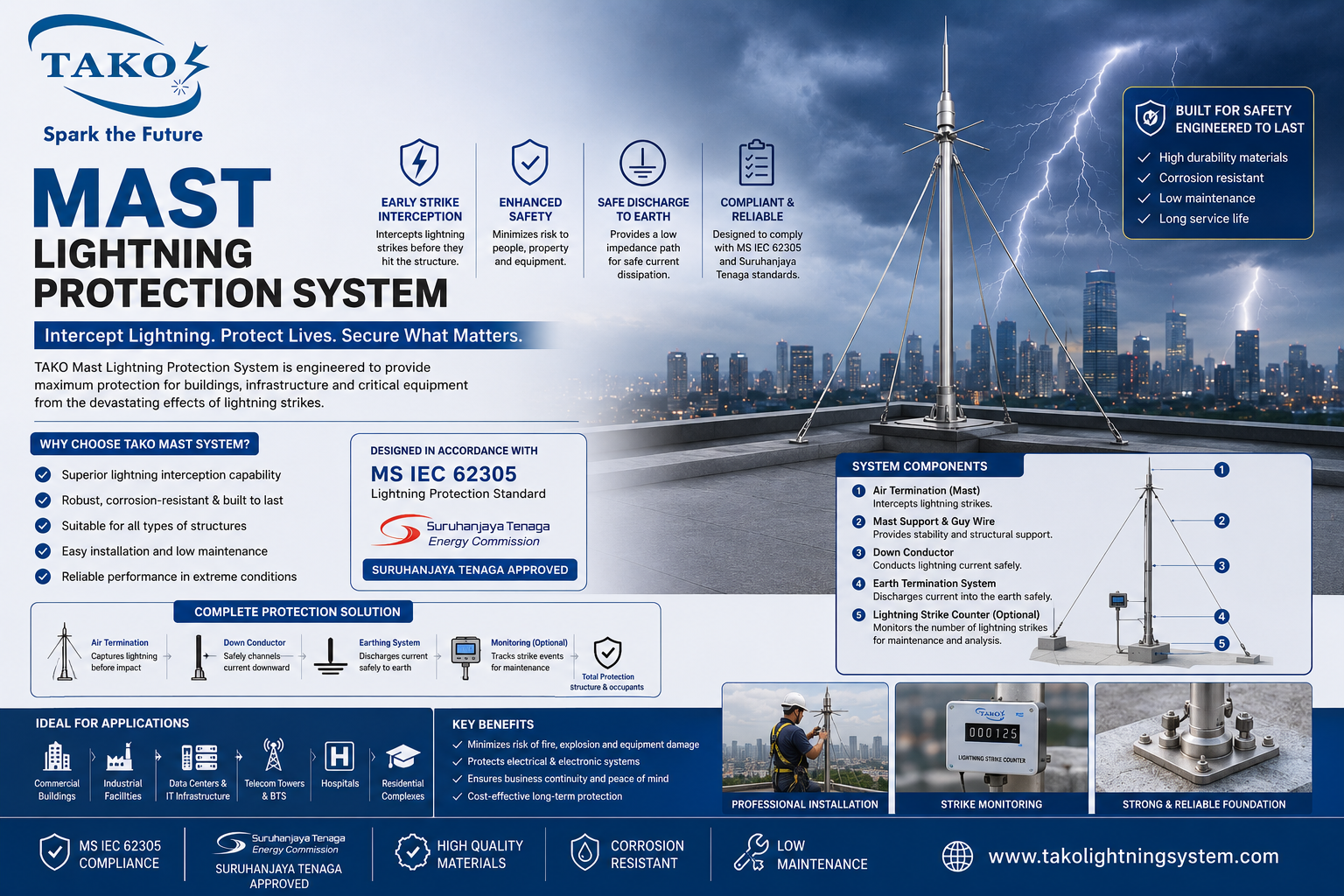
At its core, a mast lightning protection system is a free-standing or guyed structure designed to intercept lightning strikes before they can reach a protected object. Unlike a rod attached directly to a building, a mast system creates a dedicated “zone of protection” over a specific area.
Think of it as a vertical sentinel. Whether it’s a 30-foot steel pole or a 100-foot fiberglass structure, the goal of the mast lightning protection system is to provide a preferred path for lightning to follow, safely guiding the massive electrical discharge into the earth without it ever touching your critical equipment.
The Key Components
Every effective mast lightning protection system consists of four primary parts:
- The Air Terminal: The pointed rod at the very top that initiates the “upward leader” to meet the lightning strike.
- The Mast Structure: The physical pole, which can be conductive (metal) or non-conductive (fiberglass/FRP).
- The Down Conductor: A heavy-duty cable that carries the current down to the ground.
- The Grounding System: A network of rods and plates buried in the earth to dissipate the energy safely.
Why Choose a Mast System Over Traditional Methods?
You might wonder why you can’t just slap a rod on the roof and call it a day. The reality is that for sites with explosive materials or highly sensitive electronics, “close” isn’t good enough.
A mast lightning protection system offers “isolated” protection. By placing the mast at a calculated distance from the structure, you eliminate the risk of “side-flashing”—a dangerous phenomenon where lightning jumps from the conductor into the building’s internal wiring.
This isolation is why a mast lightning protection system is the preferred choice for:
- Ammunition & Explosive Storage: Where a single spark could be catastrophic.
- Data Centers: Where electromagnetic interference (EMI) from a nearby strike could wipe hard drives.
- Electrical Substations: To shield massive transformers from direct hits.
How to Install Lightning Rod (The Mast Edition)
If you are looking for how to install lightning rod components within a mast setup, you need to follow a precise engineering workflow. This isn’t a DIY weekend project; it requires adherence to standards like NFPA 780 and IEC 62305.
Google Featured Snippet: Step-by-Step Installation
How to Install a Lightning Rod on a Mast System
- Site Risk Assessment: Determine the required “Zone of Protection” using the Rolling Sphere Method.
- Foundation Preparation: Pour a concrete base designed to handle local wind loads and mast height.
- Mount the Air Terminal: Secure the lightning rod to the top of the mast.
- Run the Down Conductor: Attach the conductor to the mast, ensuring it follows the most direct path to the ground with no sharp bends.
- Install the Grounding Grid: Drive ground rods at least 10 feet into the earth and connect them to the down conductor.
- Bonding: Ensure all nearby metallic structures are bonded to prevent potential differences.
- Testing: Verify the system has a ground resistance of less than 10 ohms (ideally under 5 ohms).

Technical Standards: The “Brain” Behind the Mast
A mast lightning protection system isn’t just a pole in the ground; it is a calculated safety device. Engineers use the Rolling Sphere Method to design these systems. Imagine a giant ball (usually 100 to 150 feet in diameter) rolling over your site. Anywhere the ball touches is a potential strike point. The mast lightning protection system is designed so that the “sphere” rests on the mast and the ground, never touching the equipment in between.
In the United States, NFPA 780 provides the guidelines for these installations. Internationally, IEC 62305 is the benchmark. Using a mast lightning protection system that meets these standards ensures that insurance companies and safety inspectors will sign off on your facility’s resilience.
Conductive vs. Isolated Mast Systems
When selecting your mast lightning protection system, you have two main choices:
1. Conductive Masts (Steel or Aluminum)
In this setup, the metal mast itself often acts as the conductor. These are rugged, cost-effective, and great for general industrial use. However, because the mast is electrified during a strike, it must be placed far enough away from other structures to prevent arcing.
2. Isolated Masts (Fiberglass/FRP)
An isolated mast lightning protection system uses a non-conductive pole. The down conductor is run either inside the pole or away from it using specialized insulators. This is the “luxury” version of lightning protection, used when you need to be 100% sure that no electrical energy leaks into the surrounding environment.
Maintenance: Keeping Your Guard Up
Installing your mast lightning protection system is only half the battle. Over time, environmental factors can degrade your protection.
- Corrosion: Soil chemicals can eat away at ground rods.
- Vibration: High winds can loosen the air terminal at the top of the mast.
- Construction: Nearby site work might accidentally sever a buried ground wire.
We recommend a visual inspection of your mast lightning protection system every year and a full electrical continuity test every two to three years. If your ground resistance has crept up above 10 ohms, your system might not perform when it’s needed most.
Common Mistakes in Mast System Design
Even professional installers sometimes stumble. When implementing a mast lightning protection system, avoid these three common pitfalls:
- Inadequate Grounding: If the soil is sandy or rocky, a standard ground rod won’t work. You may need ground enhancement materials or deep-earth wells.
- Sharp Bends in Conductors: Lightning travels at incredible speeds. It doesn’t like to turn corners. A sharp 90-degree bend in your cable can cause the lightning to “jump” off the wire and find a different path through your building.
- Ignoring Wind Load: A 60-foot mast lightning protection system acts like a giant sail. If the foundation isn’t engineered for your local wind zone, the mast could collapse during the very storm it’s meant to protect you from.
Final Thoughts: Investing in Peace of Mind
At the end of the day, a mast lightning protection system is an insurance policy you hope you never have to use. But when that one-in-a-million bolt targets your facility, the quality of your mast, your understanding of how to install lightning rod components, and your commitment to maintenance will be the only things standing between safety and disaster.
Don’t leave your infrastructure to chance. A properly engineered mast lightning protection system is the most reliable way to ensure that even the most powerful storms pass by without leaving a mark.
Ready to Secure Your Assets?
Don’t wait for the next storm season to find out if your site is vulnerable. Our team specializes in high-performance mast lightning protection system design and installation. From soil resistivity testing to full NFPA-compliant installations, we provide the expertise you need to stay grounded.
Disclaimer
The information provided in this blog is intended for general informational purposes only. Prices, specifications, and availability may vary depending on suppliers, location, and market conditions. Readers should verify details directly with suppliers or manufacturers before making purchasing decisions. The author and website are not responsible for any errors, omissions, or outcomes resulting from the use of this information. Always consult a professional for advice tailored to your specific needs.
TAKO’s Credentials


FAQ for the Mast Lightning Protection System
How high does my mast need to be?
This depends on the area you need to protect. Using the Rolling Sphere Method, an engineer will determine the height needed to ensure your equipment stays within the “cone of protection” created by the mast lightning protection system.
Can I use a mast for my home?
While possible, a mast lightning protection system is usually overkill for residential properties unless you have a very large estate or specialized sensitive equipment. Rooftop systems are generally sufficient for homes.
Does a mast lightning protection system “attract” lightning?
No. It does not pull lightning out of the sky that wasn’t already going to strike. It simply provides a safe, low-resistance path for a strike that was already headed for your general area.
What is the lifespan of a mast lightning protection system?
With high-quality galvanized steel or FRP materials, a mast lightning protection system can last 20 to 30 years, provided the grounding system is checked regularly for corrosion.

