

Lightning Arrester for Apartment Building
When you manage or own an apartment complex, you aren’t just looking after real estate; you’re responsible for the lives and property of dozens, perhaps hundreds, of families. Among the many threats a building faces—fire, plumbing bursts, security breaches—one of the most unpredictable is a lightning strike.
Securing a high-value industrial or commercial facility requires an absolute, MS IEC 62305 compliant lightning protection system engineered to eliminate risk and effortlessly pass strict safety audits. By utilizing our proprietary Lightning Risk Assessment Software, our engineering team maps out precise strike vulnerability grids customized to your site’s physical footprint. To ensure your infrastructure is structurally protected against transient surges, we are currently extending a comprehensive Free Site Visit Offer for manufacturing complexes and corporate operators.
TAKO since 1979 has over 25+ years of Experience in offering MS IEC 62305 Compliant Best Lightning Protection System in Malaysia.


What is a Lightning Arrester for Apartment Building?
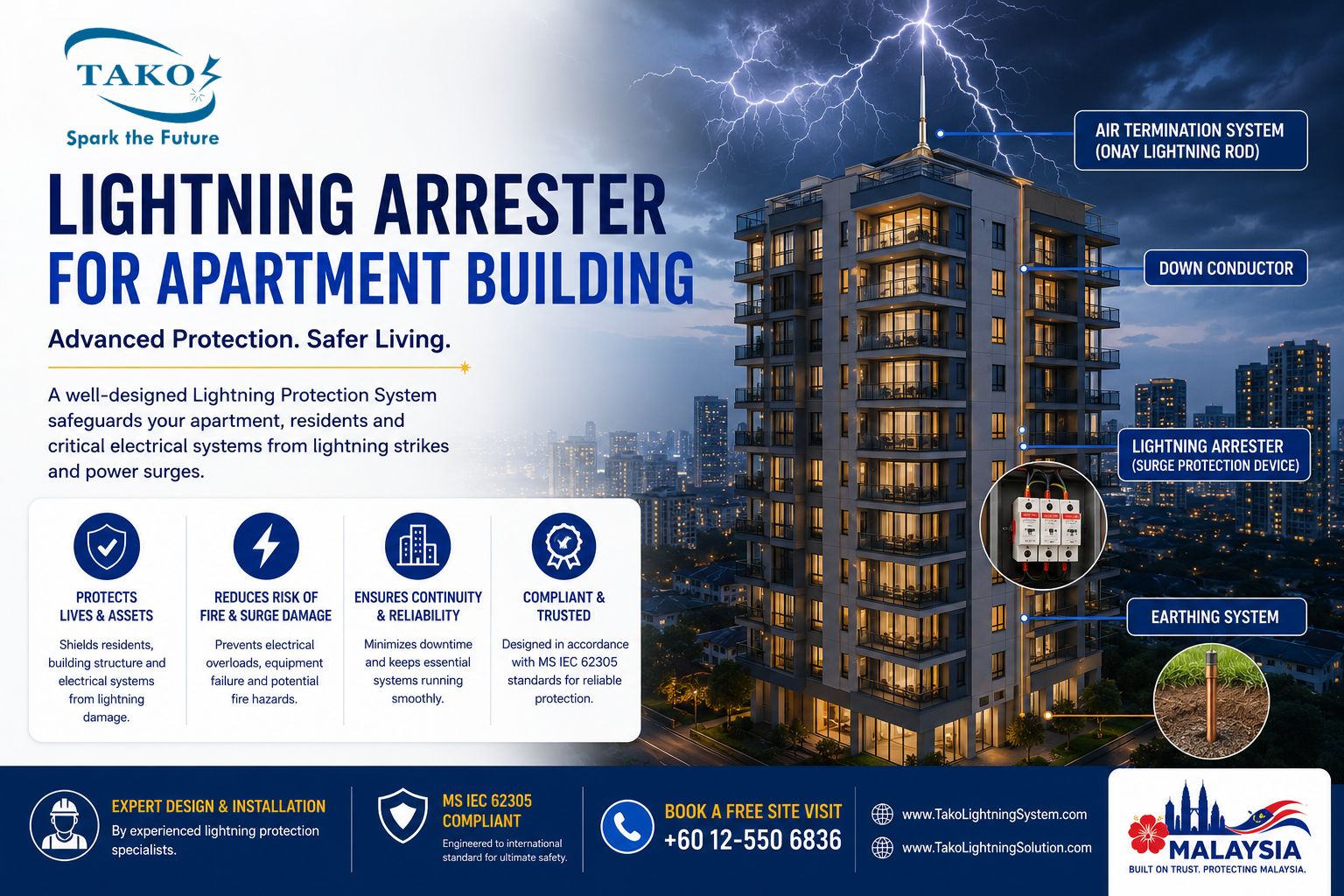
A lightning arrester for apartment building is a specialized safety device designed to protect a multi-family structure from the devastating effects of a lightning strike. It works by intercepting the strike at the highest point of the building and providing a low-resistance path for the electrical current to travel safely into the ground, bypassing the building’s structural materials and sensitive electronic systems. A complete system typically includes air terminals (rods), down conductors, and a grounding network.
Why Apartment Buildings are High-Risk Targets in Malaysia
If you look at any skyline, the apartment buildings stand out. Physics tells us that lightning tends to strike the tallest object in a given area because it provides the shortest path for the electrical discharge.
For a high-rise or mid-rise complex, the lack of a lightning arrester for apartment building is a massive liability. Beyond the immediate risk of a structural fire, a strike can cause “side-flashing,” where the current jumps from a conductor to another grounded object—like a tenant’s television or a kitchen appliance.
Furthermore, modern buildings are packed with sensitive electronics. We’re talking about smart thermostats, security cameras, high-speed internet hubs, and sophisticated elevator motherboards. A strike without a lightning arrester for apartment building can fry these systems instantly, leading to hundreds of thousands of dollars in replacement costs and massive tenant dissatisfaction.
How Does a Lightning Protection System (LPS) Work?
It is a common misconception that a lightning arrester for apartment building “attracts” lightning. It doesn’t. Instead, it offers a “preferred path.”
Think of it as a bypass lane on a highway. When the lightning is about to hit, the system provides a highly conductive copper or aluminum route that is much easier to travel through than concrete or wood.
The system consists of three main parts:
- The Air Terminal (The Rod): This is the visible part of the lightning arrester for apartment building located on the roof.
- The Down Conductor: Heavy-duty cables that carry the current down the sides of the building.
- The Grounding System: Rods driven deep into the earth to safely dissipate the energy.
By installing a lightning arrester for apartment building, you are essentially creating a cage around the structure that keeps the electricity on the outside.

How to Install Lightning Rod Systems: A Step-by-Step Overview
If you are wondering how to install lightning rod systems on a large-scale residential building, it is important to know that this is not a DIY project. It requires an understanding of electrical engineering and local building codes. However, here is the professional process for how to install lightning rod protection correctly:
Step 1: Site Risk Assessment
Before learning how to install lightning rod components, a technician must calculate the “risk index” of the building. This includes the building’s height, the frequency of thunderstorms in the area, and the type of construction materials used.
Step 2: Designing the Path
The key to how to install lightning rod systems effectively is the layout of the conductors. They must be installed without sharp bends. Lightning travels at incredible speeds; if the conductor has a 90-degree turn, the electricity might “jump” off the wire and go through the wall instead.
Step 3: Installing Air Terminals
When considering how to install lightning rod terminals, they must be placed at the highest points, including chimneys, HVAC units, and elevator penthouses. On a flat roof, these are usually spaced about 20 feet apart.
Step 4: Running Down Conductors
In the process of how to install lightning rod cables, the goal is to have at least two paths to the ground from every rod. This ensures that if one path is damaged, the other can still handle the load of a lightning arrester for apartment building.
Step 5: Grounding
This is the most critical part of how to install lightning rod systems. Rods are driven at least 10 feet into the soil. If the ground is rocky, specialized chemical grounding or grounding plates may be used to ensure the lightning arrester for apartment building can actually dump the charge into the earth.
Types of Lightning Arresters for Apartment Buildings
When selecting a lightning arrester for apartment building, you have a few technological choices.
1. Franklin Rods (The Traditional Choice)
Named after Benjamin Franklin, these are the pointed metal rods you see on most rooftops. They are reliable, simple, and the foundation of most lightning arrester for apartment building designs.
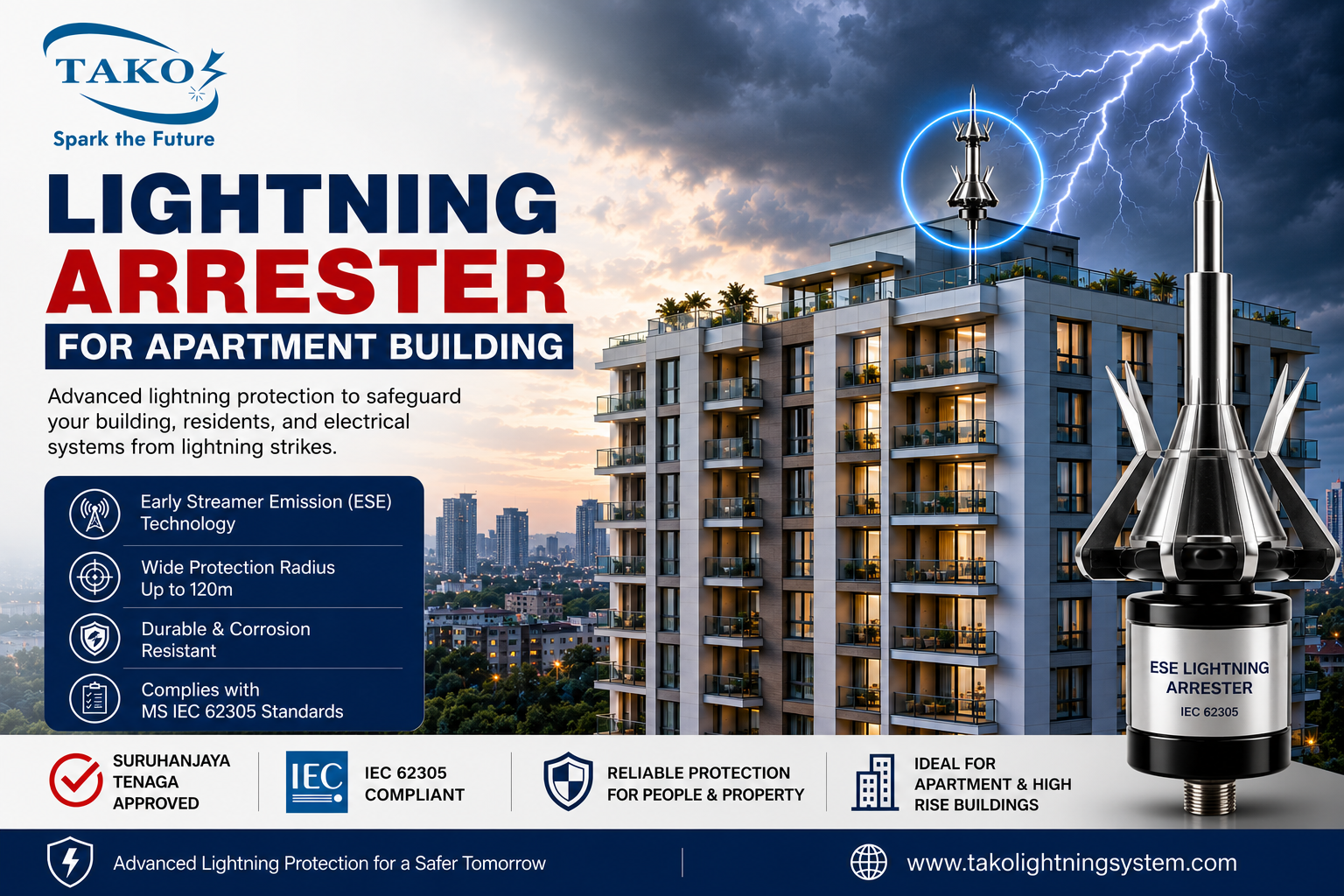
2. Early Streamer Emission (ESE) Arresters
Some modern buildings opt for an ESE lightning arrester for apartment building. These are designed to trigger a “streamer” upward slightly sooner than a traditional rod, theoretically protecting a larger radius. While popular in Europe, they are often used in conjunction with standard rods in the US.
3. Surge Protection Devices (SPDs)
A lightning arrester for apartment building isn’t complete without internal surge protection. While the rods handle the direct hit, SPDs handle the “invisible” power surges that travel through the power lines during a storm.
Compliance and Standards (MS IEC 62305)
You cannot simply throw a piece of metal on a roof and call it a lightning arrester for apartment building. To be effective and to satisfy insurance requirements, the system must adhere to MS IEC 62305 (Standard for the Installation of Lightning Protection Systems).
If your lightning arrester for apartment building isn’t UL-certified or LPI-certified (Lightning Protection Institute), your insurance provider might deny a claim following a strike. Always ask your contractor for a “Master Label” certificate once the installation is complete.
Maintenance: Don’t “Set it and Forget it”
Because a lightning arrester for apartment building is constantly exposed to the elements, it can degrade. Wind can loosen terminals, and roofing contractors often accidentally disconnect cables while making repairs.
- Annual Visual Inspections: Look for loose cables or corrosion.
- Professional Testing: Every 3–5 years, have an expert test the “ground resistance.” If the soil has dried out or shifted, your lightning arrester for apartment building might not be able to discharge electricity effectively.
- Post-Strike Inspection: If you know the building was hit, call a pro immediately. The high heat of a lightning strike can sometimes melt components of the lightning arrester for apartment building, leaving you unprotected for the next storm.
The Cost-Benefit Analysis of Lightning Arrester Installation for Building: Is it Worth It?
The price of a lightning arrester for apartment building varies based on the size of the roof and the height of the structure. For a standard apartment block, you might spend anywhere from $8,000 to $30,000.
When you look at it that way, a lightning arrester for apartment building is one of the most cost-effective insurance policies you can buy. It protects your capital investment and ensures the safety of your residents.
Enhancing Tenant Trust
In today’s competitive rental market, safety is a selling point. When tenants see a well-maintained lightning arrester for apartment building, it sends a message: The management cares about my safety and my property. Mentioning your lightning protection system in your building’s safety brochure can actually be a minor but effective marketing tool for high-end luxury apartments.
Conclusion: Don’t Leave Safety to Chance
The weather is becoming more unpredictable, and “once-in-a-century” storms are happening every few years. Protecting your property with a high-quality lightning arrester for apartment building is a proactive step that pays dividends in peace of mind and financial security.
Knowing how to install lightning rod systems correctly is the difference between a system that works and a system that fails when you need it most. Don’t wait for a catastrophe to happen before you take action.
Ready to Protect Your Building in Malaysia?
Don’t wait for the next storm cloud to appear on the horizon. Our team of certified experts specializes in lightning arrester for apartment building design and installation.
We will walk you through exactly how to install lightning rod protection tailored to your specific architectural needs. Ensure your residents are safe and your infrastructure is secure—get a quote today!
Disclaimer
The information provided in this blog is intended for general informational purposes only. Prices, specifications, and availability may vary depending on suppliers, location, and market conditions. Readers should verify details directly with suppliers or manufacturers before making purchasing decisions. The author and website are not responsible for any errors, omissions, or outcomes resulting from the use of this information. Always consult a professional for advice tailored to your specific needs.
TAKO’s Credentials


FAQ: Lightning Arrester for Apartment Building
Does a lightning arrester for apartment building attract more lightning?
No. A lightning arrester for apartment building does not attract lightning; it simply provides a safe path for it if it was going to strike the building anyway.
Can I install it myself?
No. Understanding how to install lightning rod systems requires specialized knowledge of grounding resistance and surge suppression. Always use a certified professional.
How long does a lightning arrester for apartment building last?
With proper maintenance, a high-quality system can last the entire lifespan of the building’s roof, typically 20–30 years.
Will it protect my tenants’ laptops?
A lightning arrester for apartment building protects the structure. To protect individual electronics, you must also have Surge Protection Devices (SPDs) installed at the main electrical panels.

