
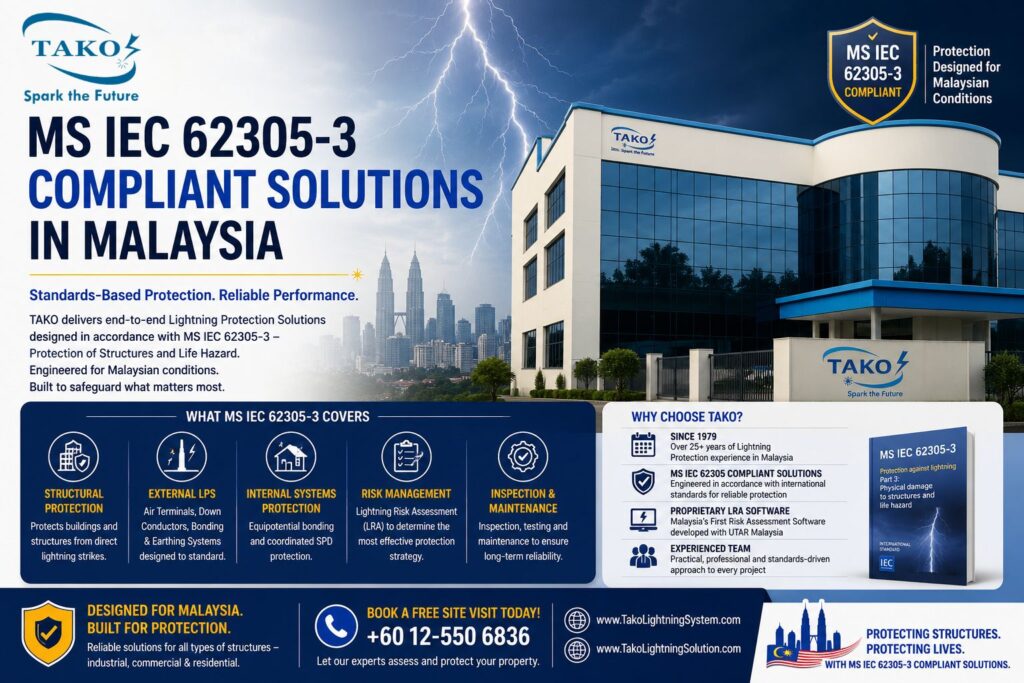
MS IEC 62305-3- What is this Malaysian regulatory compliance standards about?
MS IEC 62305-3 is the Malaysian adoption of the international standard IEC 62305-3, which focuses on protection against lightning—specifically addressing physical damage to structures and life hazards. This standard provides guidelines for implementing lightning protection systems (LPS) to safeguard buildings and infrastructure from direct lightning strikes.
TAKO since 1979, with over decades of experience offering MS IEC 62305 Compliant Lightning Protection in Malaysia.
⚡ MS IEC 62305-3 Structural Protection & Air Termination Validator
Verify rolling sphere radii, mesh grid sizing, downconductor spacing, and BOMBA/ST compliance.

Main scope of MS IEC 62305-3:
- External Lightning Protection System (LPS)
- Air terminals (lightning rods / ESE)
- Down conductors
- Earthing (grounding) system
- Protection against physical damage
- Fire
- Explosion
- Structural damage caused by lightning current
- Human safety
- Reduction of electric shock risk
- Control of touch voltage and step voltage
- Equipotential bonding
- Bonding of metallic parts and electrical systems to prevent dangerous potential differences
It covers key aspects such as air-termination systems, down conductors, earthing arrangements, and separation distances to minimize risks of fire, explosion, and structural damage. By complying with MS IEC 62305-3, engineers and designers can ensure effective lightning risk mitigation, enhancing safety for occupants and preserving assets in accordance with national and international best practices

Malaysia’s Green Energy Boom: Exposing a Critical Lightning Protection Gap
As Malaysia ambitiously expands its renewable energy portfolio, a powerful, natural adversary looms: lightning. The nation’s tropical climate makes it one of the world’s lightning hotspots.
This reality is creating a surge in searches for “solar farm lightning protection” and “wind turbine lightning risk,” yet much of the available information fails to address the specific, high-stakes requirements for these large-scale investments. The key to bridging this gap lies in a standard many are still struggling to implement correctly: MS IEC 62305-3.
The Scale of the Challenge at a Glance
The numbers speak for themselves. With sprawling solar farms and towering wind turbines becoming common sights, the risk of catastrophic lightning damage is no longer a fringe concern—it’s a primary operational threat. A generic approach to lightning protection is simply not enough.
Beyond the Lightning Rod: Why Renewables Need a Specialized Defence
Protecting a multi-hectare solar farm or a 150-meter wind turbine is vastly more complex than protecting a simple building. Here’s why a detailed understanding of standards like MS IEC 62305-3 is non-negotiable.
Unlike a compact building, solar and wind farms are massive, distributed electronic systems. They present a huge target for direct strikes and are extremely susceptible to secondary effects like surges and overvoltage, which can fry inverters, control systems, and transformers far from the initial strike point. A robust plan under MS IEC 62305-3 accounts for all these interconnected risks.
This standard is not a simple checklist. It mandates a comprehensive Risk Assessment (as per Part 2 of the standard) to determine the required level of protection. It covers not only direct strike protection (Part 3) but also crucial Surge Protection Devices (SPDs) for all electrical and electronic systems (Part 4). Skipping the risk assessment phase is a common but critical failure in project planning.
Energy providers face immense practical challenges. Achieving effective low-resistance grounding, a cornerstone of any protection system, can be incredibly difficult and expensive in Malaysia’s diverse terrain, from rocky highlands to marshy lowlands. Proper implementation of the grounding and bonding network as specified in MS IEC 62305-3 is vital for dissipating the immense energy of a lightning strike safely.
Compliance vs. Consequence: A Tale of Two Farms
The difference between adhering to and ignoring a comprehensive lightning protection strategy is stark. Consider two hypothetical solar farms facing a typical Malaysian thunderstorm.
Farm A: MS IEC 62305-3 Compliant
- Protection: Comprehensive system based on risk assessment, including air terminals, robust grounding, and coordinated SPDs.
- Outcome: A direct strike is safely conducted to the ground. Minor, localized surge protector replacement needed.
- Result: Minimal downtime (hours), protected assets, and preserved revenue stream.
Farm B: Inadequate Protection
- Protection: Basic, non-engineered lightning rods with poor grounding and no coordinated surge protection.
- Outcome: A strike causes cascading failures. Multiple inverters are destroyed, and control systems are fried.
- Result: Catastrophic downtime (weeks/months), huge replacement costs, and significant lost revenue.
The Bottom Line: An Investment, Not an Expense
Ultimately, a thorough and professional lightning protection system, designed and implemented according to the full scope of MS IEC 62305-3, is one of the most critical investments for any renewable energy project in Malaysia. It moves beyond a cost-benefit analysis of individual components (like Early Streamer Emission vs.
Franklin rods) and focuses on engineering a holistic solution for asset resilience. As Malaysia powers its future with green energy, ensuring these valuable assets are shielded from our electrifying skies is paramount for long-term success and profitability.

Why Smart Cities Fail: The Overlooked Lightning Crisis in Malaysia’s 5G Rollout
As Malaysia accelerates towards a future defined by the Malaysia Smart City Framework, our urban landscapes are being woven into a complex digital fabric of 5G towers, IoT sensors, and intelligent infrastructure. But amid the buzz of high-speed connectivity and data-driven efficiency, a critical vulnerability is being ignored.
Existing security protocols focus on cyber threats, while the very real physical threat of lightning is leaving our multi-billion Ringgit investment dangerously exposed. Comprehensive planning according to MS IEC 62305-3 is the only way to ensure our smart cities are resilient, not fragile.
The Electrified Urban Environment
The scale of deployment is massive. Each 5G tower, traffic sensor, and public CCTV camera is a potential failure point. A single lightning strike doesn’t just damage one device; it can send a destructive surge through the network, causing cascading failures that undermine the entire smart city concept. Adherence to MS IEC 62305-3 is not just a recommendation; it’s a requirement for operational continuity.
Rethinking Protection for a Connected Age
The old model of placing a single lightning rod on the tallest building is obsolete. A smart city’s nervous system is distributed everywhere—on lampposts, atop buildings, and along highways. This requires a new, more granular approach to protection.
IoT sensors and 5G microcells are built with sensitive microelectronics that operate on low voltages. They are exceptionally vulnerable to induced surges from nearby lightning strikes, not just direct hits. Without correctly specified Surge Protection Devices (SPDs) at the device level—a key part of a full MS IEC 62305-3 strategy—these crucial data collectors can be easily destroyed.
A lightning surge entering one part of the network, such as a 5G tower, doesn’t stop there. It travels along power and data lines (both copper and fiber optic with metallic members), potentially damaging equipment in a completely different location, from the central data center to the traffic light controller down the street. This highlights the need for a coordinated protection plan across all interconnected systems.
The most effective approach is to apply the Lightning Protection Zone (LPZ) concept from MS IEC 62305-3 at a city-wide scale. Each building, tower, or cluster of street-level sensors is treated as its own zone. Protection is layered, with robust external protection to handle direct strikes and multiple stages of internal SPDs to shield sensitive electronics at every boundary crossing from a less protected to a more protected zone. This ensures resilience from the macro-structure down to the microchip.
Interactive: Smart City Vulnerability Hotspots
Click on each component to reveal its specific lightning risks and protection needs.
5G Microcell Towers
Risk: High exposure to direct strikes. Surges can travel down power/fiber lines to network hubs. Solution: A complete system following MS IEC 62305-3, including air terminals, down conductors, and coordinated SPDs on all incoming/outgoing lines.
Street-Level CCTV & Sensors
Risk: Highly susceptible to induced surges from nearby strikes on larger structures. Solution: Localized, device-level SPDs on both power and data ports are critical. Proper equipotential bonding to the lamppost or mounting structure is essential.
Intelligent Traffic Systems
Risk: Widespread, interconnected network controlling critical infrastructure. A failure can cause chaos. Solution: Zonal protection for control cabinets, with SPDs protecting controllers, and loop detectors embedded in the road.
Building a Truly Resilient Future
The dream of a seamless, efficient smart city can be short-circuited by a single thunderstorm. Planners and engineers must look beyond software and see the physical reality of our climate. Integrating a comprehensive lightning and surge protection strategy, rigorously based on the principles of MS IEC 62305-3, is not an optional add-on; it is the very foundation upon which a reliable and resilient smart Malaysia must be built.

The Hidden Danger of Green Buildings: Why Your Rooftop Garden Needs Lightning Protection
Malaysia’s skyline is rapidly turning green. Driven by the Green Building Index (GBI), architects are integrating lush rooftop gardens, vertical farms, and biophilic designs into modern high-rises. While these features promote sustainability and well-being, they also introduce complex and often overlooked lightning risks.
A standard protection system designed for a concrete roof is dangerously inadequate for a vegetated one. Proper safety compliance requires a deep, specific application of the MS IEC 62305-3 standard, tailored to these unique architectural environments.
The New Face of Urban Risk
These statistics illustrate a new reality: green building features fundamentally change how a structure interacts with atmospheric electricity. Architects and engineers must balance the push for sustainability with the uncompromising need for safety, a challenge that goes to the core of how MS IEC 62305-3 is applied in practice.
Why Traditional Lightning Protection Fails on Green Buildings
A simple air terminal network isn’t enough when the building itself becomes an active part of the electrical landscape. Here are the critical failure points that must be addressed.
A green roof consists of layers of soil, drainage mats, and membranes. When saturated with rainwater, this entire assembly becomes a massive, semi-conductive plane. This can drastically alter the effectiveness of a grounding system and create multiple, unpredictable termination points for a lightning strike. Designing an effective equipotential bonding network in this environment is a key challenge under MS IEC 62305-3.
The metallic trellises, support wires, and automated irrigation pipes common in vertical gardens create unintended conductive paths down the building’s facade. If a strike occurs, the immense electrical current can “flash over” from these elements through the wall to the building’s interior steel frame or electrical wiring, posing a severe risk to occupants and electronics on multiple floors.
Placing solar panels on a green roof or installing rainwater harvesting systems introduces more complexity. These systems are not only vulnerable to direct strikes but also to powerful surges. A comprehensive protection strategy must include correctly rated Surge Protection Devices (SPDs) for the solar inverters and pump controllers, a critical but often forgotten aspect of a full MS IEC 62305-3 implementation.
Biophilic Design Risk Spotlight
Beyond the general principles, specific green features require special attention to mitigate unique hazards.
Rooftop Common Areas
Presents a direct risk to human safety. Protection systems must create a “safe zone” by ensuring step and touch voltages are kept below dangerous levels during a strike, a complex task on a conductive green roof.
Rooftop Water Features
Pools and fountains are highly conductive and provide a direct path for lightning current into the building’s rebar and plumbing systems, requiring specialized bonding and isolation techniques.
Solar Integrated Facades
When solar panels are part of the building’s skin, they become part of the external lightning protection system. They must be robustly bonded and protected against surges to prevent widespread system failure.
Designing for Resilience: A Non-Negotiable Approach
The aesthetic and environmental benefits of green buildings are undeniable, but they cannot come at the cost of safety. Achieving a truly sustainable and resilient building means embracing these new challenges head-on.
A meticulously planned lightning protection system, developed through a thorough risk assessment and in strict accordance with the principles of MS IEC 62305-3, is not an option—it is an absolute necessity for the high-rise green buildings of tomorrow.

Why Your Data Center’s Lightning Protection is Obsolete: MS IEC 62305-3 Gaps in the Cloud Era
As Malaysia solidifies its position as a premier data center hub, the conversation around uptime and resilience has never been more critical. Hyperscale facilities are being built, but many are protected by legacy lightning protection philosophies that are dangerously out of date.
Simply installing basic Surge Protection Devices (SPDs) is a check-box exercise that completely misses the greater threats defined within the comprehensive MS IEC 62305-3 standard.
For true resilience, a facility’s entire electrical ecosystem must be analyzed through the lens of MS IEC 62305-3. The failure to adopt the full scope of MS IEC 62305-3 is a significant gap. Every design choice must consider the mandates of MS IEC 62305-3, as this is central to protecting these vital assets. The principles of MS IEC 62305-3 must guide every step.
The High-Stakes Environment
These figures show that a single lightning event can have multi-million dollar consequences. This is why a superficial understanding of protection is insufficient; only a deep, engineering-led application of MS IEC 62305-3 can provide adequate security. Relying on anything less than the full MS IEC 62305-3 is a major risk.
Unseen Threats: Beyond Basic SPDs
The real danger to modern data centers lies in phenomena that basic protection overlooks. A holistic risk assessment, as mandated by MS IEC 62305-3, reveals these hidden vulnerabilities. The entire MS IEC 62305-3 document is designed to address these complex issues, and operators must understand the full MS IEC 62305-3 framework.
When lightning strikes the ground near a facility, the ground potential in that area can rise by thousands of volts. This creates a massive voltage difference between the facility’s grounding system and remote utility grounds, causing current to flow *into* the facility through data and power lines. This is a primary focus of MS IEC 62305-3. A proper equipotential bonding system, as detailed in MS IEC 62305-3, is the only defense. The complexity of GPR is why MS IEC 62305-3 is so vital. We must consult MS IEC 62305-3 for guidance. The solution is found within MS IEC 62305-3, and ignoring MS IEC 62305-3 here is catastrophic. Engineers use MS IEC 62305-3 to calculate these risks. True protection relies on MS IEC 62305-3.
The intense magnetic field from a lightning channel can induce damaging currents in nearby wiring without any physical connection. This can corrupt data on servers and disrupt network traffic, causing chaos without tripping a single breaker. The shielding and routing requirements of MS IEC 62305-3 are designed to mitigate this. The zonal protection concept within MS IEC 62305-3 is crucial. This is a core part of the MS IEC 62305-3 philosophy. We must follow the MS IEC 62305-3 guidelines for cable management. The entire approach of MS IEC 62305-3 is holistic. This threat is specifically addressed in MS IEC 62305-3. A proper MS IEC 62305-3 installation prevents this.
SPDs are just one part (Part 4) of a four-part system defined by MS IEC 62305-3. A complete strategy starts with a Risk Assessment (Part 2 of MS IEC 62305-3), which determines the required physical Lightning Protection System (LPS) detailed in MS IEC 62305-3 (Part 3). These systems must work in coordination. This integrated system approach is the foundation of MS IEC 62305-3. You cannot pick and choose parts of MS IEC 62305-3. The value of MS IEC 62305-3 is its completeness. We recommend a full audit based on MS IEC 62305-3. Future technologies like AI prediction will supplement, not replace, the fundamental principles of MS IEC 62305-3. The standard MS IEC 62305-3 remains key. The future is built on MS IEC 62305-3.
Containerized vs. Traditional: A New Protection Paradigm
The rise of modular data centers introduces new challenges that must be addressed within the framework of MS IEC 62305-3. The approach to applying MS IEC 62305-3 must be flexible.
Traditional Data Centers
Challenge: Large, complex structures with extensive power and data cabling running over long distances, making them highly susceptible to the effects of GPR and EMI.
MS IEC 62305-3 Solution: A robust, integrated Lightning Protection System (LPS) with extensive equipotential bonding of all metallic services at the building entrance, fully compliant with MS IEC 62305-3. This is a classic application of MS IEC 62305-3.
Modular/Containerized Data Centers
Challenge: Multiple, isolated metal enclosures. A strike to one container can create a huge voltage difference to an adjacent one, risking flashover and equipment damage.
MS IEC 62305-3 Solution: Creation of a single, unified equipotential plane by bonding all containers together and to a common grounding system. This is a critical requirement of MS IEC 62305-3. Each container’s protection must adhere to MS IEC 62305-3.
The Bottom Line: Engineering Over Assumption
Protecting a modern data center is not a task for assumptions; it is a task for precise engineering. The only standard that holistically addresses all the complex electrical risks in our lightning-prone climate is MS IEC 62305-3.
Moving beyond obsolete, SPD-only strategies and embracing the full, comprehensive framework of MS IEC 62305-3 is the only way to ensure the cloud has a solid ground.
A final check against MS IEC 62305-3 is always required. The importance of MS IEC 62305-3 cannot be overstated for these critical facilities.
The Deadly Blind Spot in Offshore Safety: Navigating Lightning Risks Beyond Land
As Malaysia expands its blue economy—from bustling ports like Port Klang to pioneering floating solar projects and critical offshore oil rigs—it confronts a uniquely powerful adversary: lightning at sea.
The marine environment is unforgiving, introducing challenges like saltwater corrosion, unstable grounding, and explosive atmospheres that render land-based protection methods insufficient.
Applying standards like MS IEC 62305-3 in this setting is not a simple copy-paste exercise; it is a complex engineering challenge that demands specialized knowledge and materials to prevent catastrophic failure.
The Offshore Risk Matrix
These factors create a perfect storm of risk. A lightning protection system that works perfectly on land can fail in months at sea. This is why a proper risk assessment based on MS IEC 62305-3 is the critical first step for any marine or offshore asset.
Why the Sea Changes Everything for Lightning Protection
Applying the principles of lightning safety to marine assets reveals three critical challenges that standard documentation doesn’t fully address without expert interpretation.
Salt spray and high humidity relentlessly attack conventional lightning protection materials like copper and galvanized steel. Corrosion increases resistance, rendering down conductors and grounding points ineffective when a strike occurs. This requires special considerations for MS IEC 62305-3 components, demanding the use of marine-grade stainless steel, bronze, or specialized coatings to ensure long-term system integrity.
An offshore platform or ship is not connected to “earth ground.” Its ground plane is the surrounding seawater. While highly conductive, creating a reliable, low-impedance connection from the top of a rig to the sea is complex. The grounding principles of MS IEC 62305-3 need adaptation, focusing on creating a comprehensive equipotential bonding network across the entire structure to prevent dangerous voltage differences during a strike.
On oil and gas platforms or LNG tankers, the smallest spark can lead to a catastrophic explosion. A lightning strike’s path must be meticulously controlled to prevent “side-flashing” in hazardous (Ex) zones. This requires specialized protection required by MS IEC 62305-3, such as insulated conductors and certified isolating spark gaps (ISGs) to safely bridge different metallic structures without creating an ignition source.
High-Risk Offshore Asset Spotlight
Applying MS IEC 62305-3 requires a tailored approach for each unique marine asset class.
Floating Solar Farms
These sprawling arrays present a massive target. Protection must address not just the panels but also the floating pontoons and submerged cabling. Ensuring electrical continuity across a constantly moving platform is a significant challenge for any MS IEC 62305-3 installation.
Oil & Gas Platforms
Protection is mission-critical, focusing on the flare stack, communication towers, and helideck. A strict interpretation of MS IEC 62305-3 is vital to ensure the safety of personnel and prevent environmental disasters in these complex, high-risk environments.
Vessels at Port (e.g., LNG Tankers)
The ship-to-shore interface during loading/unloading is a point of extreme vulnerability. Proper equipotential bonding between the ship and terminal is paramount to prevent arcing that could ignite flammable cargo. The framework of MS IEC 62305-3 is the foundation for these procedures.
Navigating Forward Safely
For Malaysia’s marine industries to thrive, we cannot afford a blind spot when it comes to lightning. The principles are clear, but the application is an art form. A marine-focused application of MS IEC 62305-3, led by engineers who understand the unique hostility of the sea, is essential to protect lives, secure multi-billion-dollar assets, and ensure the resilience of our nation’s vital offshore infrastructure.

Preserving the Past: How Malaysia’s Heritage Sites Are Failing at Lightning Protection
Malaysia’s historical treasures, from the iconic churches of Malacca to the clan temples of George Town, are irreplaceable links to our past. Yet, these structures are facing a silent but powerful threat: lightning. Incidents of strikes on heritage buildings serve as a stark reminder of their vulnerability.
The core dilemma lies in a fundamental conflict: how do we apply modern safety standards, such as MS IEC 62305-3, to buildings that were never designed to accommodate them, without compromising the very historical character we seek to preserve?
The Conservationist’s Tightrope
This balancing act is where standard approaches fall short. A shiny copper conductor or a bulky air terminal, while effective, can be an eyesore that defaces a centuries-old facade. This has led to a dangerous inertia, where the risk of aesthetic damage often outweighs the perceived risk of a lightning strike.
Unique Challenges in Heritage Protection
Protecting a heritage building is far more complex than a modern one. Conservators and engineers must navigate a minefield of issues that are not explicitly detailed in standard guidelines.
How do you securely fasten a conductor to brittle, 200-year-old masonry or ancient timber beams without causing irreparable damage? The physical installation of a system that adheres to MS IEC 62305-3 can be more destructive than the potential lightning strike itself. The methods used must be non-invasive, a consideration far beyond the scope of typical construction, yet crucial for adapting MS IEC 62305-3 principles.
Visible lightning rods and conductors can permanently alter the historic character and skyline of a building, violating the core tenets of conservation. This aesthetic conflict is the single biggest barrier to implementing a compliant system. Conservators need solutions that meet the safety objectives of MS IEC 62305-3 without being seen, a task that requires specialized products and creative engineering.
Many heritage sites have shallow foundations and are surrounded by landscaped grounds or historic paving. Installing an effective, low-resistance grounding system as required by MS IEC 62305-3 without significant and disruptive excavation is a major technical hurdle. This often requires innovative grounding solutions that differ from standard-practice installations.
Modern Solutions for Ancient Structures
Fortunately, technology has evolved. The choice is no longer between an ugly, safe building and a beautiful, vulnerable one. Discreet protection systems can achieve the goals of MS IEC 62305-3 while remaining virtually invisible.
Concealed Conductors
Flat, tape-like conductors made of tin-coated copper can be hidden in mortar joints or behind architectural features. They can be painted to match the building’s material, providing a functional and invisible path to ground that aligns with MS IEC 62305-3.
Architectural Air Terminals
Instead of standard rods, air terminals can be custom-made to replicate existing historical finials, spires, or other decorative elements. This integrates the protection system into the building’s original design, preserving its historical integrity.
Catenary Wire Systems
For complex or extremely fragile roofs, a grid of thin wires can be suspended above the structure. This “catenary” or “mesh” system intercepts lightning strikes without ever touching the historic roof, a specialized approach to achieving MS IEC 62305-3 compliance.
A Future for Our Past
Preserving Malaysia’s heritage requires a thoughtful fusion of old and new. It demands an approach that respects the past while employing the best of modern engineering.
By intelligently adapting the robust safety principles of MS IEC 62305-3 with these discreet technologies, we can ensure our most precious historical sites are protected from the ravages of nature, allowing them to stand tall for generations to come.
Why Your DIY Lightning Protection is Worse Than Nothing: MS IEC 62305-3 Myths Busted
Every monsoon season, Malaysian home office owners and SME operators anxiously search for “cheap lightning protection.” This often leads them down a dangerous path of DIY hacks and misinformation found on social media.
While the intent to protect valuable equipment is understandable, a poorly designed system doesn’t just fail to protect—it actively increases the danger to both property and lives. Understanding the basic principles of a real standard like MS IEC 62305-3 is the first step toward genuine safety.
The Small Business Shockwave
Lightning Protection Myth Busters
Before you hammer a metal rod into your garden, let’s debunk some of the most common and dangerous myths. These misconceptions stand in direct opposition to the engineered safety approach of MS IEC 62305-3.
Reality: A cheap power strip with “surge protection” is like a bucket in a tsunami. A real lightning surge is thousands of times more powerful and can enter through power, internet, and phone lines. The MS IEC 62305-3 standard calls for a coordinated, multi-stage system of Surge Protection Devices (SPDs) at the building’s entry point and near sensitive equipment to safely manage this immense energy.
Reality: While a tree might take a direct hit, the danger doesn’t stop there. The lightning current radiates through the ground (Ground Potential Rise) and can jump from the tree to your building (“side-flash”), often with explosive force. Proper protection as per MS IEC 62305-3 creates a defined, safe path for the current completely around your structure.
Reality: An improperly installed rod can be worse than nothing. It can attract a strike but fail to dissipate the energy safely if the ground resistance is too high. This can lead to the energy finding more destructive paths through your building’s wiring or foundation. The MS IEC 62305-3 standard requires a tested, low-resistance grounding system, which often involves multiple rods or other types of electrodes bonded together.
The Danger Zone: DIY vs. Reality
Here’s why some popular DIY “solutions” are a recipe for disaster compared to the engineered approach required by MS IEC 62305-3.
DIY Myth: Grounding to a Water Pipe
A common but incredibly dangerous hack involves connecting a wire from a rooftop antenna or metal object to an external water pipe or tap for “grounding.”
MS IEC 62305-3 Reality: Dedicated System
This electrifies your entire plumbing system, creating a lethal touch hazard at every tap, shower, and metal pipe inside your home. A proper system uses a dedicated, isolated grounding electrode network.
A Practical Path Forward for SMEs
While a full-scale industrial system might be overkill for a small office, the core principles of MS IEC 62305-3 are scalable. The goal is to create a safe and controlled path for lightning energy to bypass your valuable assets. For any small business, the best investment is not in DIY materials, but in professional advice.
A qualified engineer can perform a basic risk assessment based on MS IEC 62305-3 and recommend a cost-effective solution that focuses on the two most critical areas: a correctly installed grounding system and coordinated SPDs on all incoming service lines.
Ultimately, lightning protection is a science governed by the laws of physics, not a weekend project. Attempting to shortcut this science is gambling with your business and your safety. Following the guidance derived from MS IEC 62305-3 is the only proven way to turn a gamble into an engineered certainty.
The Invisible Threat: How Lightning is Killing Malaysia’s Underground Infrastructure
When lightning disrupts Kuala Lumpur’s MRT or causes widespread fiber optic outages, the cause seems counterintuitive. How can something underground be vulnerable to a threat from the sky? The answer lies in a dangerous blind spot in infrastructure planning: the failure to correctly apply lightning protection principles to buried assets.
The standard for protection, MS IEC 62305-3, is often seen as an above-ground document, but its core principles are absolutely critical for subterranean safety. Without proper adherence to these engineering standards, we risk more outages and system failures.
The Buried Risk Profile
Protecting these extensive and vital assets requires a deep dive into the nuances of modern protection standards. The risk assessment process must be adapted for these unique scenarios, and we need certified experts to lead these projects. A sound engineering solution must be based on a complete framework.
Why “Underground” Does Not Mean “Safe”
A direct hit is not the primary danger. The main threat is Ground Potential Rise (GPR), where a nearby lightning strike injects enormous current into the soil, creating massive voltage differences that can destroy buried equipment.
GPR can cripple sensitive railway signaling systems, causing phantom signals or complete failures. The principles of equipotential bonding are designed to combat this. Bonding the rails, communication lines, and structural steel into a single unified plane is an essential engineering tenet that is not optional for public safety.
Though the fiber core is glass, the cable often contains a metallic strength member or armored sheath. This buried metal line acts as a perfect antenna for lightning-induced ground currents. Surge Protection Devices (SPDs) are non-negotiable at every point where the cable enters a building or joins equipment.
Lightning currents flowing through soil can accelerate electrochemical corrosion of the steel reinforcements in tunnels and other concrete structures, weakening them over time. A proper protection installation considers this long-term risk by providing a preferred, low-resistance path for the current to ensure system durability.
Engineering the Defense Beneath Our Feet
Protecting these assets requires proactive, specialized solutions derived from proven engineering principles, not guesswork. For example, installing a distributed grounding grid along a tunnel’s length or using shielded duct banks for utilities are advanced applications of a holistic protection philosophy.
The Only Way Forward
The invisible threat is real, but it is manageable with the right expertise. The only path forward is a deep, engineering-led commitment to the principles of modern lightning protection standards. It is our duty as engineers and planners to apply these concepts correctly.
A final audit based on a comprehensive framework like MS IEC 62305-3 is essential before any project goes live, ensuring our infrastructure has a robust and reliable defense.

What is MS IEC 62305-3?
It’s a Malaysian Standard for lightning protection, focusing on preventing physical damage to structures and life hazards.
Does MS IEC 62305-3 apply to all buildings?
Yes, but the level of protection depends on the structure’s risk assessment.
What are the key components of a lightning protection system (LPS)?
Air-terminations, down conductors, earthing systems, and bonding arrangements.
How is the Lightning Protection Level (LPL) determined?
Based on risk assessment considering structure type, location, and consequences of a strike.
What materials are used for air-terminations?
Typically copper, aluminum, or stainless steel with specified thickness and corrosion resistance.
Are there separation distance requirements for LPS?
Yes, to prevent side flashes between the LPS and other conductive parts.
Does MS IEC 62305-3 cover underground structures?
Yes, but additional measures may be needed depending on soil conductivity.
How often should an LPS be inspected?
At least annually or after major modifications/extreme weather events.
Can an existing structure be retrofitted with LPS?
Yes, but compliance with MS IEC 62305-3 must be ensured.
Who can install an LPS?
Qualified professionals trained in lightning protection standards.
Does MS IEC 62305-3 cover explosive storage facilities?
Yes, with stricter requirements due to higher risk.
Is bonding with electrical systems necessary?
Yes, to prevent dangerous potential differences.
What is the role of surge protection in MS IEC 62305-3?
Not covered in Part 3 (focuses on physical damage); see Part 4 for surge protection.
Disclaimer
Disclaimer: MS IEC 62305-3: Protection against lightning – Related information. While every effort has been made to ensure accuracy, this content is not a substitute for the official Malaysian Standard (MS) published by STANDARDS MALAYSIA and Suruhanjaya Tenaga mandatory design frameworks. For specific guidance, always refer to the latest edition of MS IEC 62305-3 and WhatsApp now for consultation with recognized experts in lightning protection systems

