

You’ve spent thousands of dollars on high-end servers, high-speed switches, and state-of-the-art IP cameras. You’ve even plugged your power cables into the most expensive battery backups money can buy. But there is a “back door” into your hardware that most people completely ignore: the Ethernet cable.
A single lightning strike nearby or a fluctuation in the power grid can send a massive spike of electricity through your data lines. When that happens, your power strip won’t save you. That is why every professional setup needs a dedicated network surge protection device.
In this blog, we’re going to dive deep into why these devices are the unsung heroes of IT infrastructure and how you can choose the right one to keep your business online.
TAKO since 1979 is the Sole-Distributor of Telebahn SPD in Malaysia. It is offering the best affordable surge protectors in town.
Scan the QR Code to Contact Us for Prompt Response

Android Users may use Google Lens. iPhone (iOS) Users may Use The Camera App.


What is a Network Surge Protection Device?
A network surge protection device (also known as an Ethernet surge protector) is a specialized hardware component designed to protect networking equipment from voltage spikes on RJ45 data lines. Unlike standard power surge protectors, a network surge protection device is engineered to handle much lower voltage thresholds and faster transient speeds, diverting excess electricity to a ground wire before it can reach and destroy sensitive components like routers, switches, and network interface cards (NICs).
Why Your Ethernet Lines Are at Risk
Most people assume that surges only come through the wall outlet. However, electricity is opportunistic—it follows the path of least resistance.
If you have an outdoor IP camera, a wireless bridge on your roof, or even a long run of Ethernet cable passing near high-voltage lines, your system is vulnerable. A nearby lightning strike can create an electromagnetic pulse (EMP) that induces a current directly into your Cat6 cables. Without a network surge protection device in place, that current travels straight into your switch’s logic gates, essentially “frying” the delicate silicon.
In my years of troubleshooting network failures, I’ve seen entire server racks taken down not by a power failure, but by a surge that entered through a single unprotected outdoor access point. It’s a heartbreaking and expensive lesson to learn.
The Technical Difference: Why Power Strips Fail Data Lines
You might be wondering, “Can’t I just use a high-quality power strip?” The answer is a firm no.
A standard power surge protector is designed for 120V or 240V AC power. It has a high “clamping voltage,” meaning it won’t act until the voltage gets quite high. However, Ethernet data lines operate on tiny fractions of that voltage. A spike that is too small to trigger a power strip is more than enough to incinerate an Ethernet port.
This is where a network surge protection device becomes essential. These devices use specialized components like Gas Discharge Tubes (GDT) and Silicon Avalanche Diodes (SAD) that react in nanoseconds to even the smallest over-voltage events.
Key Specifications of a High-Quality Network Surge Protection Device
When you are shopping for a network surge protection device, you shouldn’t just buy the cheapest one on Amazon. To ensure E-E-A-T (Expertise, Authoritativeness, and Trustworthiness) standards, you need to look for specific technical ratings.
1. UL 497B Certification
This is the gold standard. If a network surge protection device is UL 497B listed, it means it has been tested specifically for data communications and fire safety. If the device doesn’t have this rating, you are essentially gambling with your hardware.
2. Clamping Voltage and Response Time
The clamping voltage is the point at which the device starts diverting energy. For a high-performance network surge protection device, you want a low clamping voltage that matches the logic levels of your equipment. Additionally, the response time should be less than 1 nanosecond. Surges move at the speed of light; your protection needs to be just as fast.
3. Insertion Loss
Since the data has to pass through the protector, there is a risk of signal degradation. A professional-grade network surge protection device will have “low insertion loss,” ensuring that your Gigabit or 10Gbps speeds aren’t throttled by the very device meant to protect them.
Where to Strategically Install Your Network Surge Protection Device
Installation isn’t just about plugging it in; it’s about placement. Based on industry best practices, here are the three critical areas where you should deploy a network surge protection device:
The “Point of Entry”
If you have any Ethernet cables coming from the outdoors (like a security camera on a pole), you must install a network surge protection device at the point where the cable enters the building. This prevents the surge from ever reaching your indoor network closet.
PoE (Power over Ethernet) Devices
PoE devices are doubly at risk because they carry both data and significant electrical power. Using a PoE-compatible network surge protection device ensures that the power delivery remains stable while protecting the data pairs from transient spikes.
The Server Rack Header
For businesses, a rack-mounted multi-port network surge protection device is the best way to centralize protection. By running all incoming lines through a single protected panel, you create a “shield” around your most expensive assets.
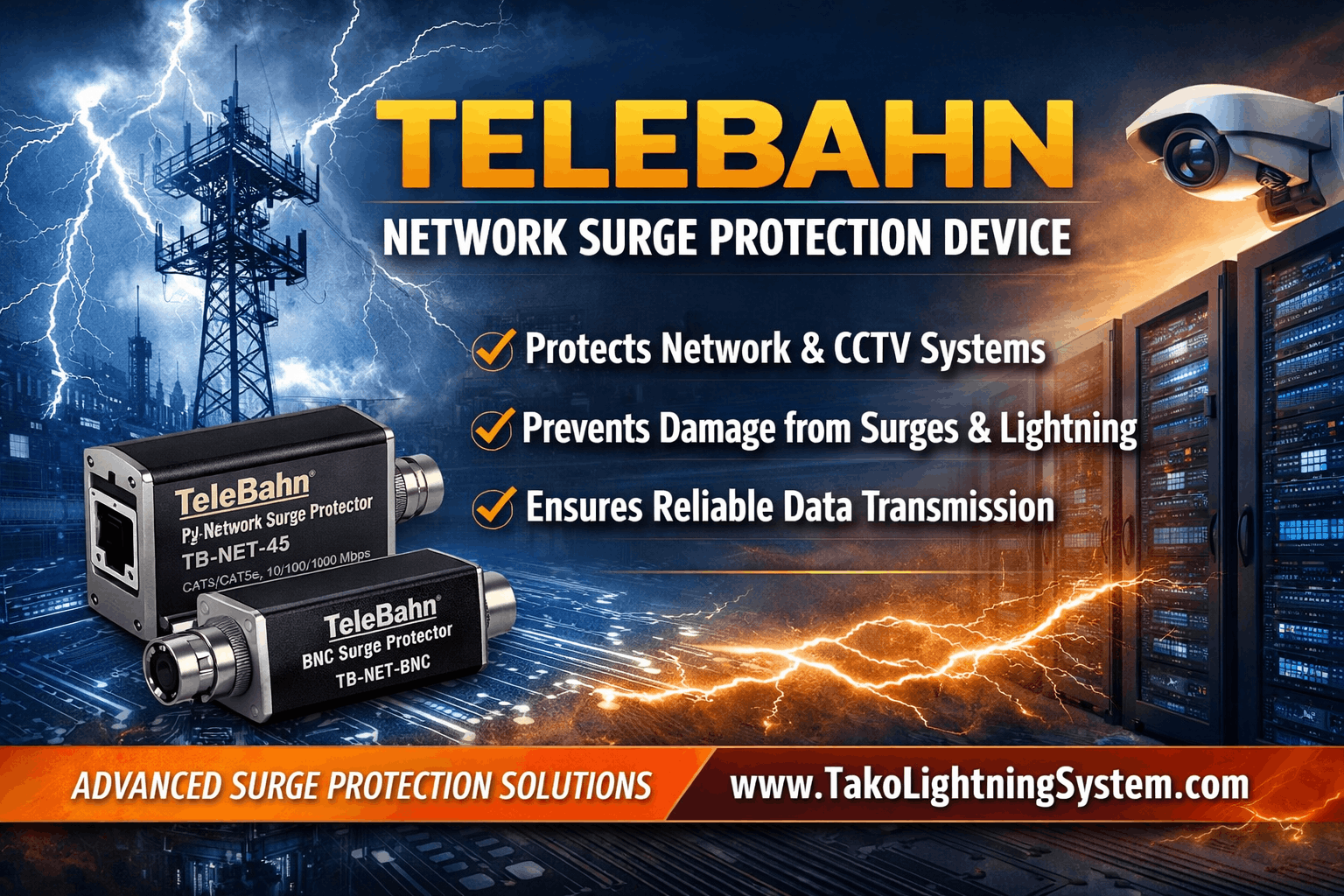
Different Types of Network Surge Protection Devices
Depending on your specific needs, there are several forms this hardware can take:
- Single-Port RJ45 Protectors: Small, inline devices perfect for protecting a single PC or a NAS.
- Multi-Port Rackmount Units: Ideal for IT rooms where you need to protect 12 to 24 lines simultaneously. A 24-port network surge protection device is standard for enterprise environments.
- Outdoor Industrial Protectors: These come in weatherproof housings (IP66 or IP67 rated) and are built to withstand extreme temperatures and direct lightning hits.
- DIN Rail Protectors: Common in industrial settings or “smart factory” floors where equipment is mounted on standardized metal rails.
The “Experience” Factor: Don’t Ignore the Ground Wire!
If there is one mistake I see people make more than any other, it is forgetting the ground wire. A network surge protection device works by “dumping” excess electricity to the ground. If you don’t connect that little green or yellow wire to a verified building ground, the device has nowhere to send the surge.
In that scenario, your network surge protection device becomes a paperweight. Always ensure your grounding path is as short and straight as possible. Bends in a ground wire can actually create impedance, causing the surge to jump back onto your data line!
Maintenance: Is Your Network Surge Protection Device Still Working?
One thing most manufacturers don’t tell you is that a network surge protection device is a “sacrificial” component. Inside the device, the components wear out every time they take a hit.
After a major storm, you should inspect your protectors. Some high-end models have an LED status light. If the light is out, the device has done its job and died so your switch could live. In my professional experience, it is a good habit to replace any network surge protection device every 3 to 5 years, even if you don’t think it has taken a hit, just to ensure the components haven’t degraded due to environmental heat.
The Cost-Benefit Analysis: Why You Can’t Afford to Wait
Let’s talk numbers. A high-quality, UL-listed network surge protection device usually costs between $30 and $60 for a single port, or roughly $300 for a rackmount version.
Compare that to:
- Replacing a 48-port PoE Switch: $2,500+
- Replacing a high-end Enterprise Firewall: $4,000+
- The cost of downtime (lost sales, employee idle time): Potentially thousands per hour.
When you look at it that way, a network surge protection device isn’t an expense; it’s the cheapest insurance policy you’ll ever buy.
Final Thoughts for IT Managers and Home Lab Enthusiasts
In the world of networking, we often focus on speed, bandwidth, and latency. We forget about the physical reality of electricity. But nature doesn’t care about your uptime.
Whether you are running a small home office or managing a multi-site enterprise, the network surge protection device is a critical layer of your defense-in-depth strategy. By selecting a device with the right certifications, installing it with a proper ground, and placing it at vulnerable entry points, you can rest easy the next time a thunderstorm rolls through.
Secure Your Network Today
Don’t wait for a disaster to prove you need protection. Audit your network today. Look for cables that go outdoors or long runs that pass near electrical interference. If those lines aren’t hitting a network surge protection device before they hit your switch, you are at risk.
Ready to protect your hardware? Contact our expert team today for a consultation on the best network surge protection device for your specific infrastructure, or browse our top-rated selection of UL-certified protectors. Protect your data, protect your hardware, and ensure your peace of mind.
Disclaimer
The information provided in this blog is intended for general informational purposes only. Prices, specifications, and availability may vary depending on suppliers, location, and market conditions. Readers should verify details directly with suppliers or manufacturers before making purchasing decisions. The author and website are not responsible for any errors, omissions, or outcomes resulting from the use of this information. Always consult a professional for advice tailored to your specific needs.
TAKO’s Credentials


